Emotional Overload in Girls: How This Comic Teaches What Words Cannot (2026)

Emotional overload in girls is one of the most misunderstood experiences in special education. The comic Emotional Overload in Girls: When Feelings Become Too Much by Prof Bermed translates neuroscience into sequential art, giving educators and parents a powerful visual tool to understand what neurodivergent girls live through daily. This guide explains how to use every page in the classroom, at home, and in IEP conversations.
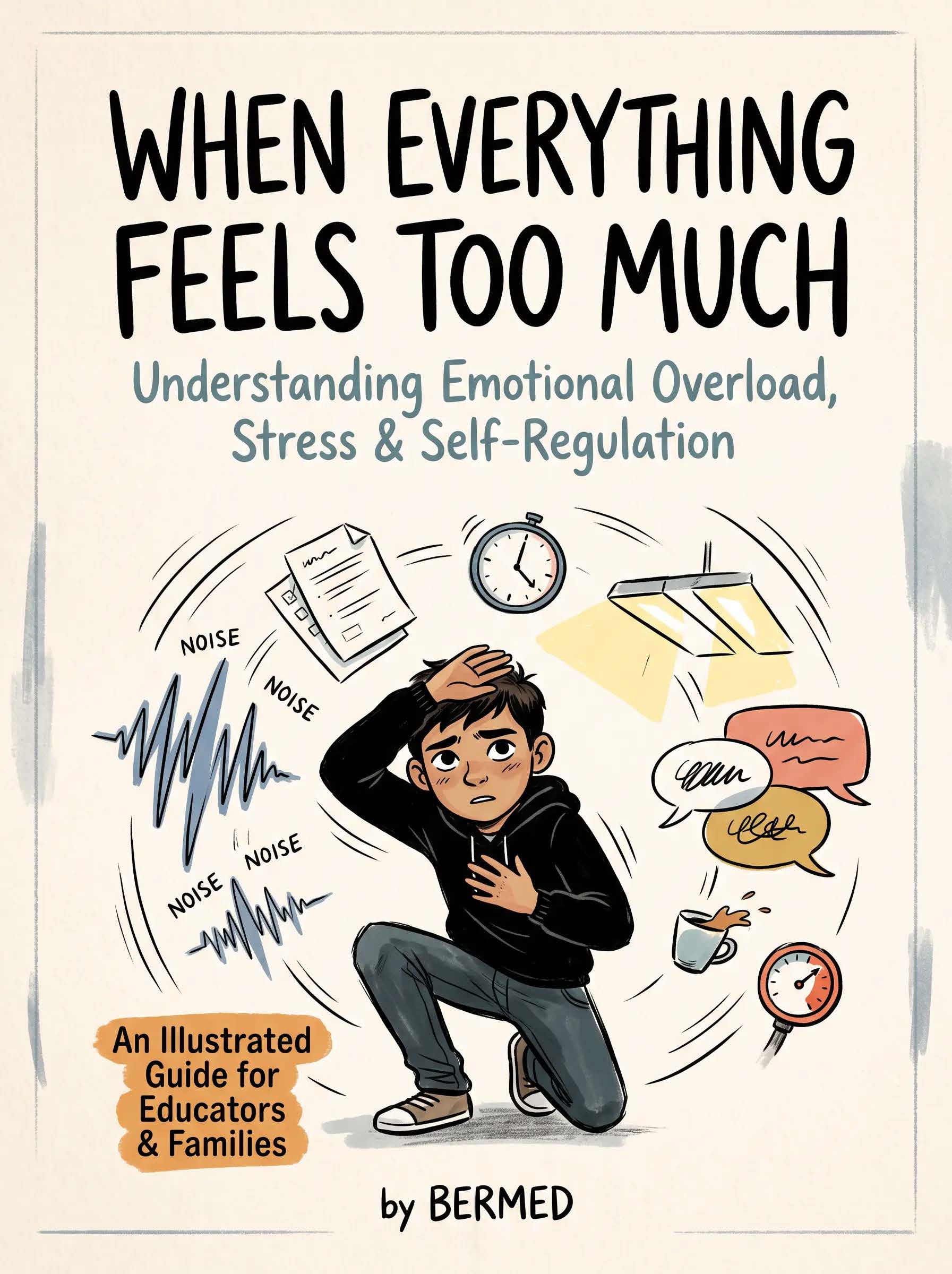
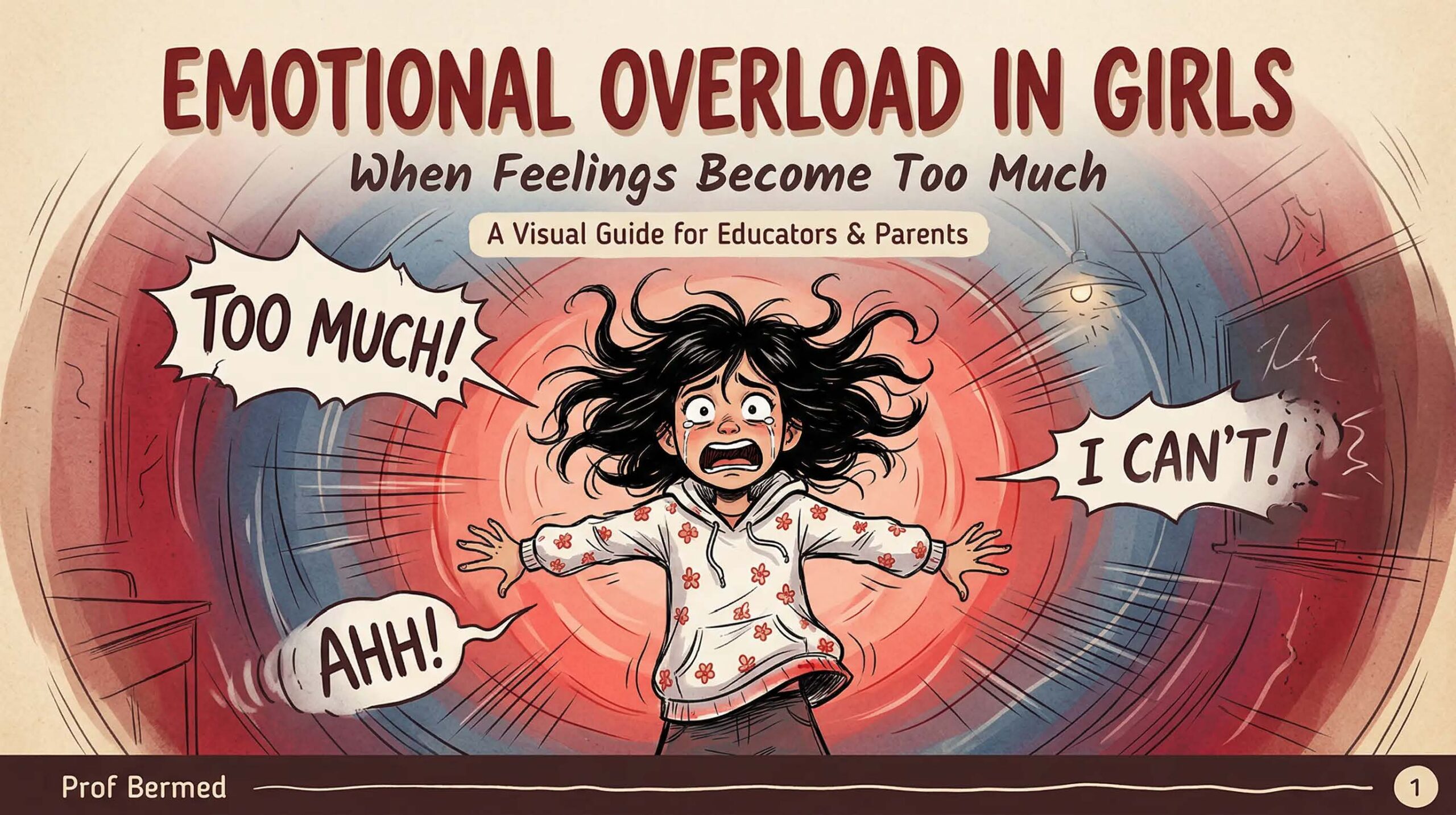
Comic book cover titled Emotional Overload in Girls — a neurodivergent girl stands in the center overwhelmed, with speech bubbles reading Too Much, I Can't, and Ahh — a visual guide for educators and parents by Prof Bermed
Emotional Overload in Girls: When Feelings Become Too Much — a 35-page visual guide by Prof Bermed for educators and parents of neurodivergent girls.

What is emotional overload in girls, and why is it so often missed?

Emotional overload in girls is not a behavior problem. It is a neurological reality. When a girl’s nervous system has processed more input than it can regulate, her body responds the only way it knows how: through shutdown, explosion, flight, or mask. The problem is that most of what happens inside her is invisible to the people around her.

Neurodivergent girls, including those with ADHD, autism, AuDHD, PDA, or anxiety, are particularly vulnerable to emotional overload because they are often working harder than their peers just to maintain the appearance of calm. By the time the storm becomes visible, it has usually been building for hours. What adults see as a sudden meltdown is almost always the final chapter of a very long story.

This is precisely what makes this comic exceptional as a pedagogical tool. It shows the full story, from the first quiet ripple to the crash, and everything that follows.
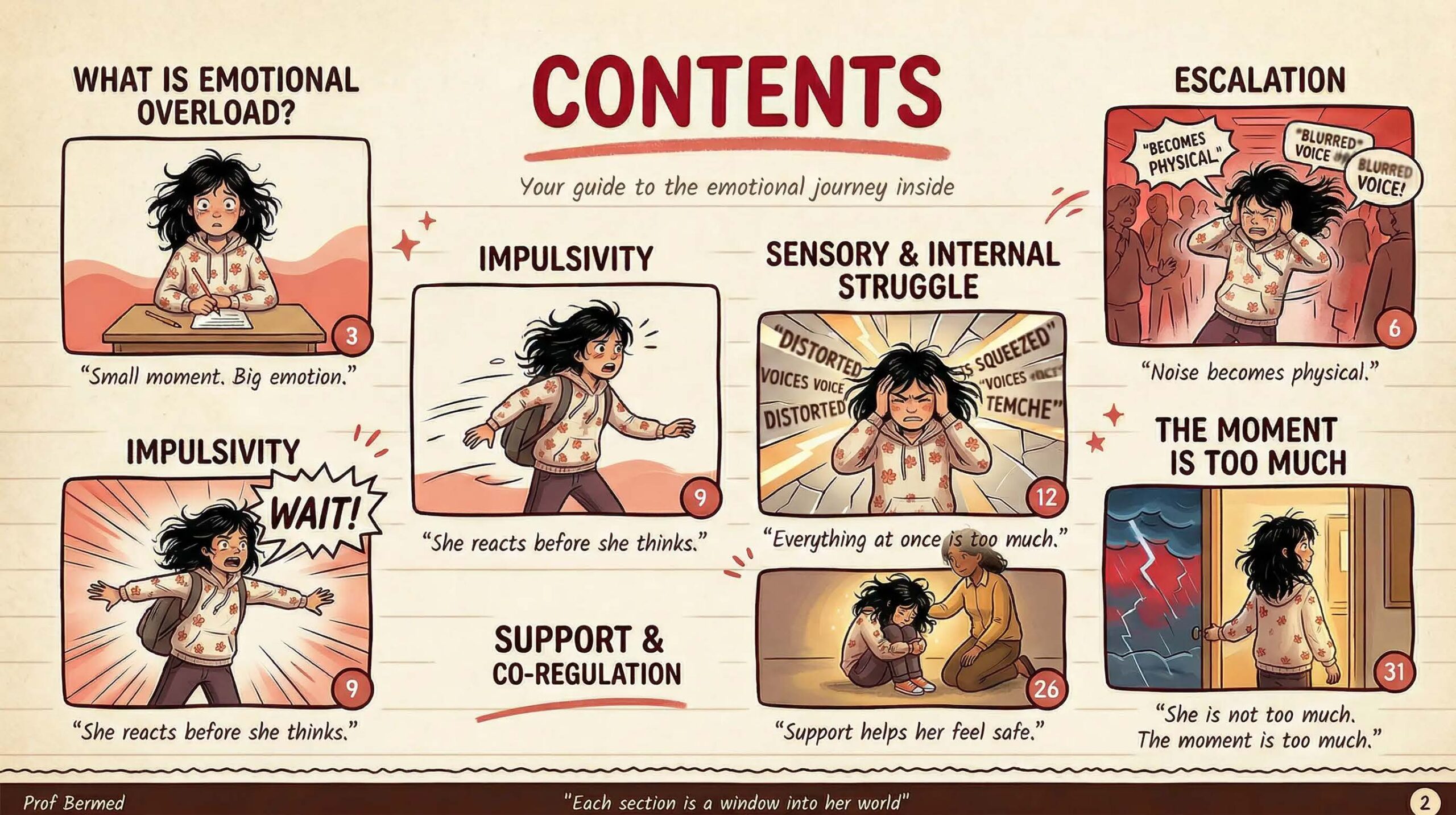
Visual table of contents for the comic Emotional Overload in Girls showing six sections: What Is Emotional Overload, Impulsivity, Sensory and Internal Struggle, Escalation, Support and Co-Regulation, and The Moment Is Too Much — each section paired with an illustration of a girl in distress
The comic covers six major themes, each a distinct window into the inner world of a neurodivergent girl navigating a neurotypical environment.

Why does a comic book work when verbal explanations do not?

Sequential art bypasses the language processing that can be overloaded during or after a difficult emotional experience. When a child is dysregulated, asking her to explain what happened verbally places an enormous cognitive demand on a system that is already depleted. A comic offers something different: a mirror that does not require words.

Research in visual learning consistently shows that narrative images activate the same neural pathways as lived experience. A student who sees herself in the panels of this comic is not just reading a story. She is watching her own interior life rendered visible, possibly for the first time. That recognition is clinically significant. It reduces shame, builds self-awareness, and opens the door to conversation.

For educators and parents, the comic provides equally important insight. It answers the question that drives so many support conversations: what is actually happening inside her during a meltdown?

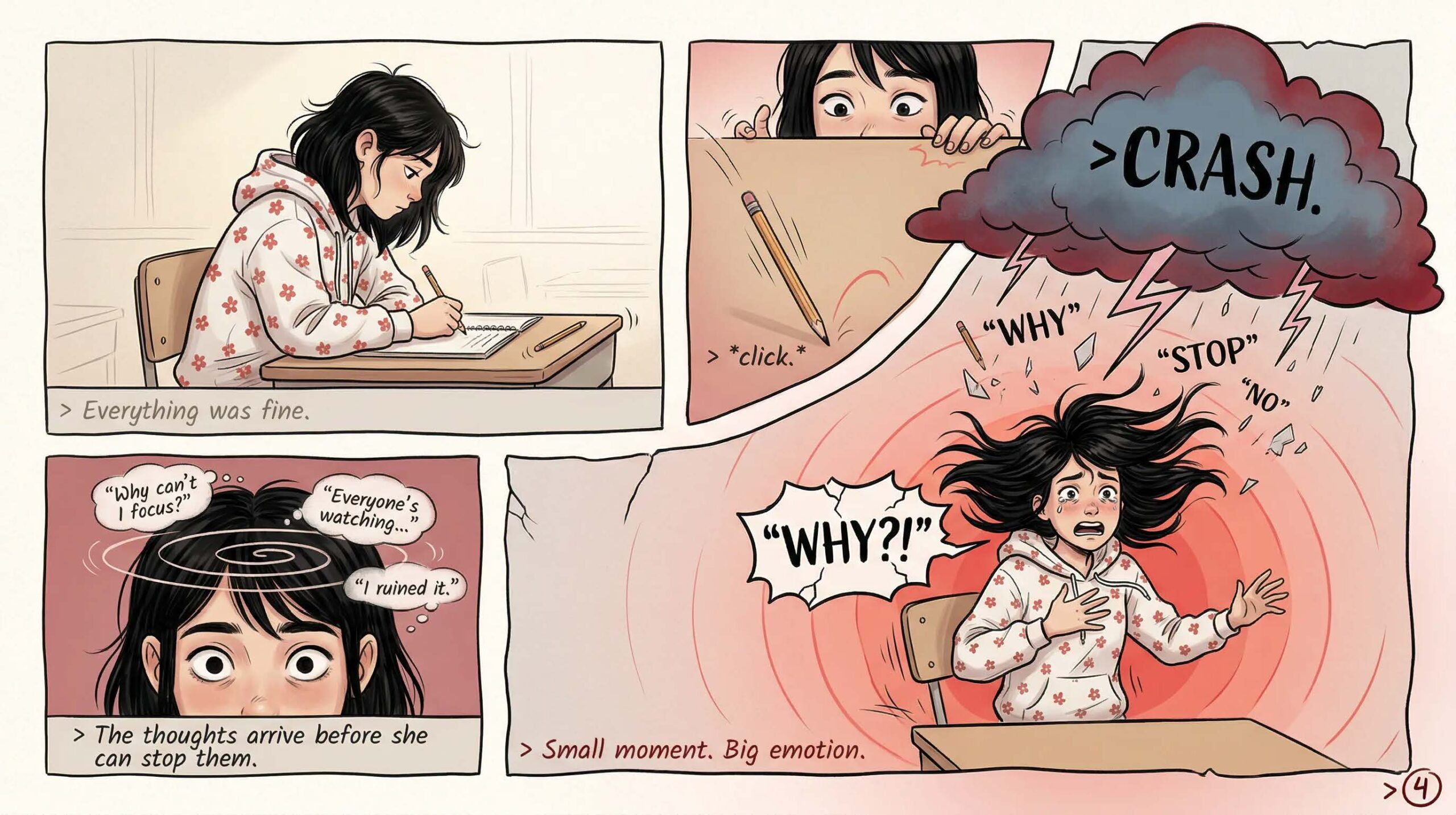
Comic page showing a girl at her school desk losing focus after dropping a pencil, with panels captioned Why Can't I Focus and Small Moment Big Emotion — illustrating emotional dysregulation triggers in neurodivergent students
A dropped pencil. For a neurodivergent girl, that small moment can activate a cascade of shame, self-monitoring, and overwhelm.
Four-panel comic showing a girl going from calm at her desk to full emotional overwhelm after a pencil drops — thought bubbles read I ruined it and Everyone's watching — captioned Small Moment Big Emotion, showing how internal thoughts escalate emotional overload in girls
The internal monologue that follows is invisible to everyone in the room, but it is already shaping what happens next.

A section-by-section pedagogical breakdown

This comic is structured in six thematic sections. Each one addresses a distinct aspect of emotional overload in girls, and each one has direct pedagogical applications.

Pages 3 to 5: Understanding that small triggers produce large responses

The opening pages introduce a concept that is foundational to working with neurodivergent girls: the trigger is almost never the real cause. A dropped pencil, a chair scraping, a glance from a classmate. These are the visible sparks. The fuel, accumulated sensory input, social anxiety, unmet regulation needs, is invisible and has been building long before that moment.
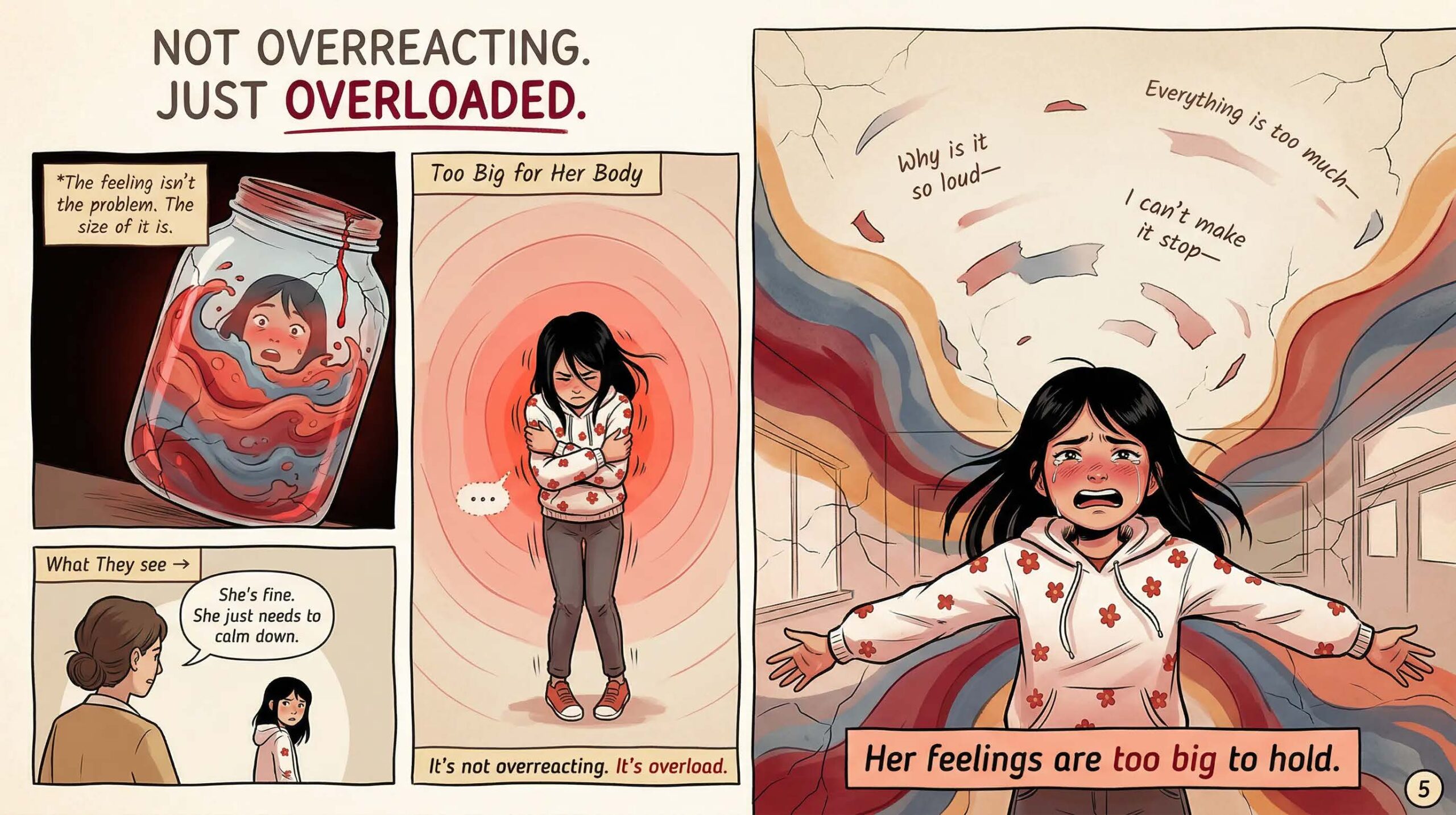
Comic page titled Not Overreacting Just Overloaded — showing a girl trapped in a jar symbolizing her emotions being too big for her body, while an adult says She's fine she just needs to calm down — illustrates how emotional overload in girls is misread by adults
“Not overreacting. Just overloaded.” This page alone reframes the conversation that educators and parents have been having about neurodivergent girls for decades.

Pedagogical use: Show pages 3 to 5 at the start of a staff professional development session. Ask: when we say a student is overreacting, what information are we missing? The jar metaphor on page 5 is particularly effective in small group discussions with students aged 10 and up.

Pages 6 to 8: The rising tide of sensory and emotional input

These pages document what the nervous system experiences as overload accumulates. The progression from “it starts quietly” to full dysregulation is rendered with rare accuracy. Educators often see only the final panel. The comic shows the four that came before it.
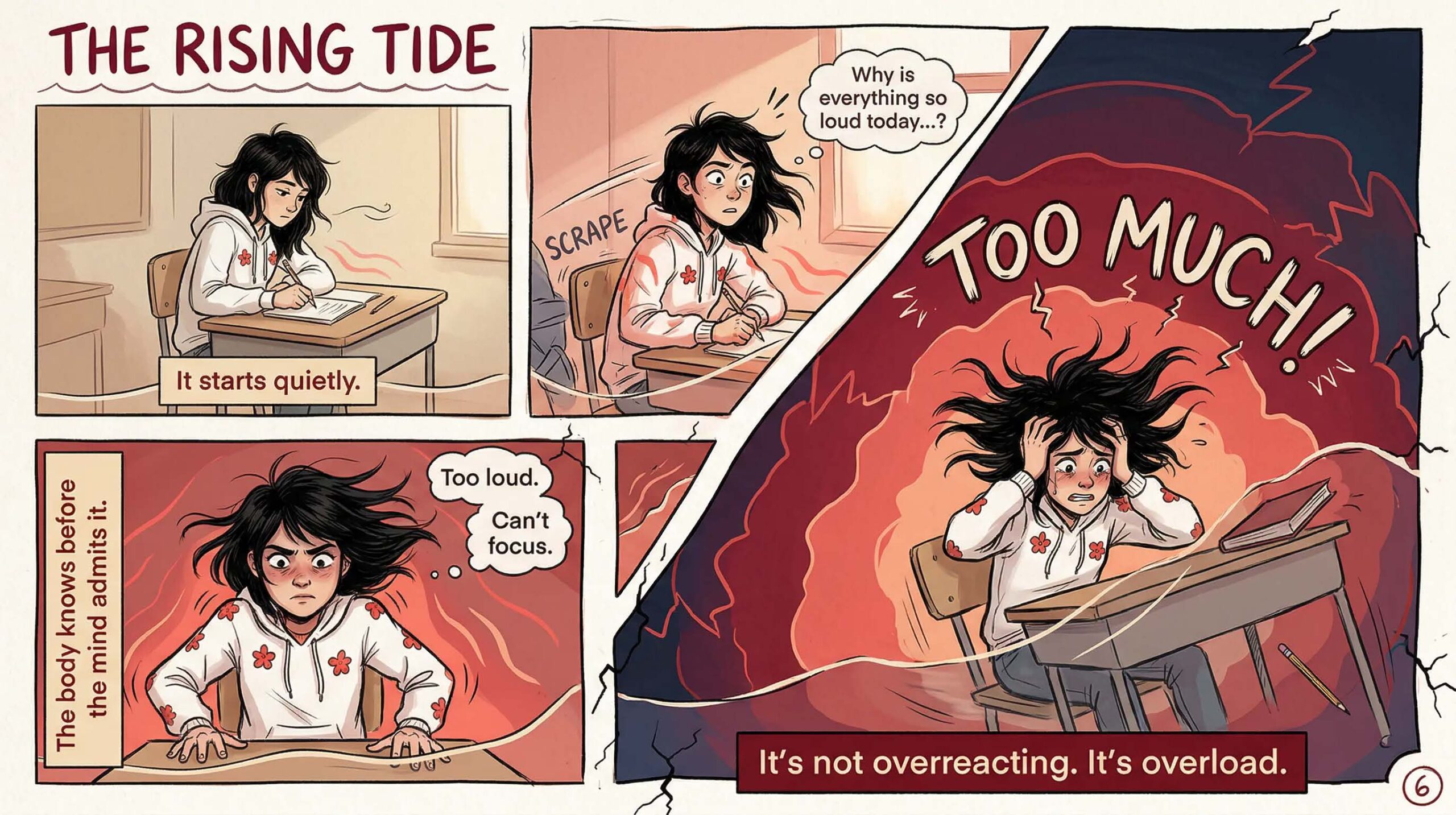
Comic page titled The Rising Tide — four panels showing a neurodivergent girl at her desk going from calm to full sensory overwhelm, with the caption It's not overreacting it's overload — depicts the gradual build-up of emotional overload in a school classroom
The body knows before the mind admits it. Recognizing early signs is the first skill in proactive support.
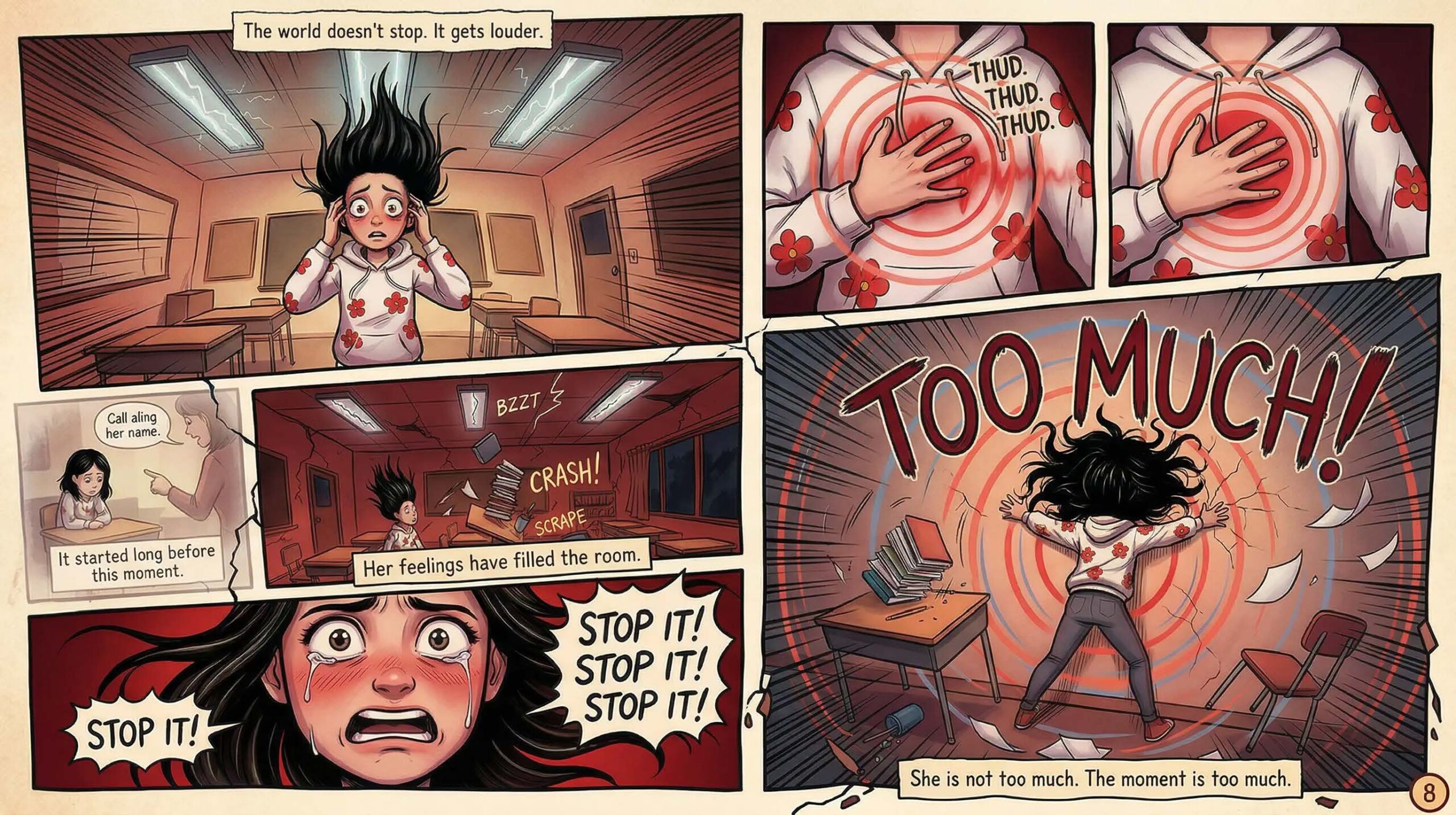
Comic page showing a girl with her hands on her ears in a chaotic classroom, with papers flying and the caption She is not too much The moment is too much — depicts a full emotional meltdown in a school setting caused by sensory overload in a neurodivergent student
“She is not too much. The moment is too much.” This distinction is at the heart of neuroaffirmative education.

Pages 7, 12, and 13: Sensory overload as physical pain

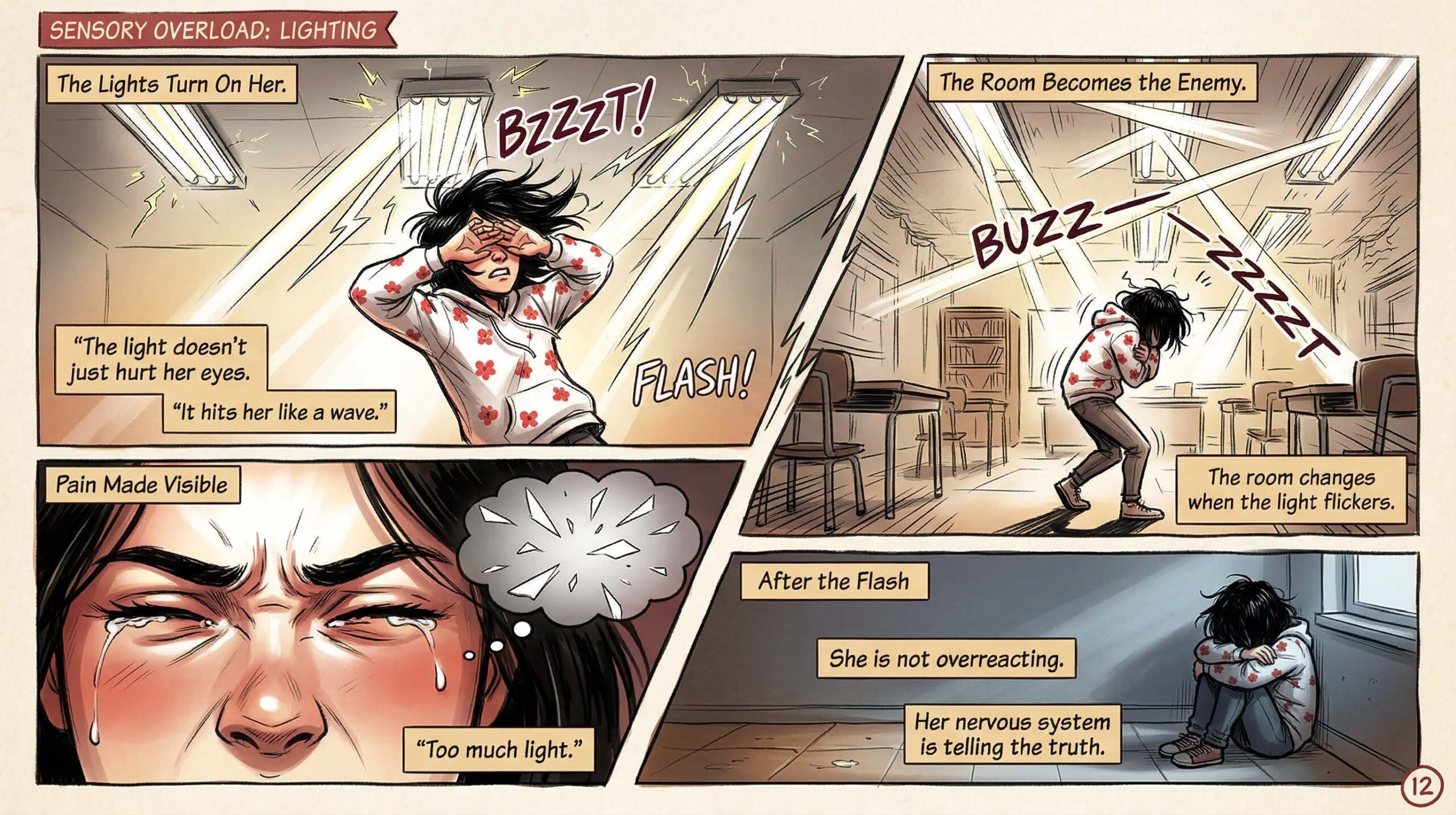
One of the most important contributions of this comic is its treatment of sensory overload not as sensitivity or preference, but as physical experience. Hallway noise hits the body like a wave. Fluorescent lights do not just hurt the eyes, they reorganize the entire sensory landscape of the room. Pages 7, 12, and 13 show this with a level of specificity that no verbal description can match.
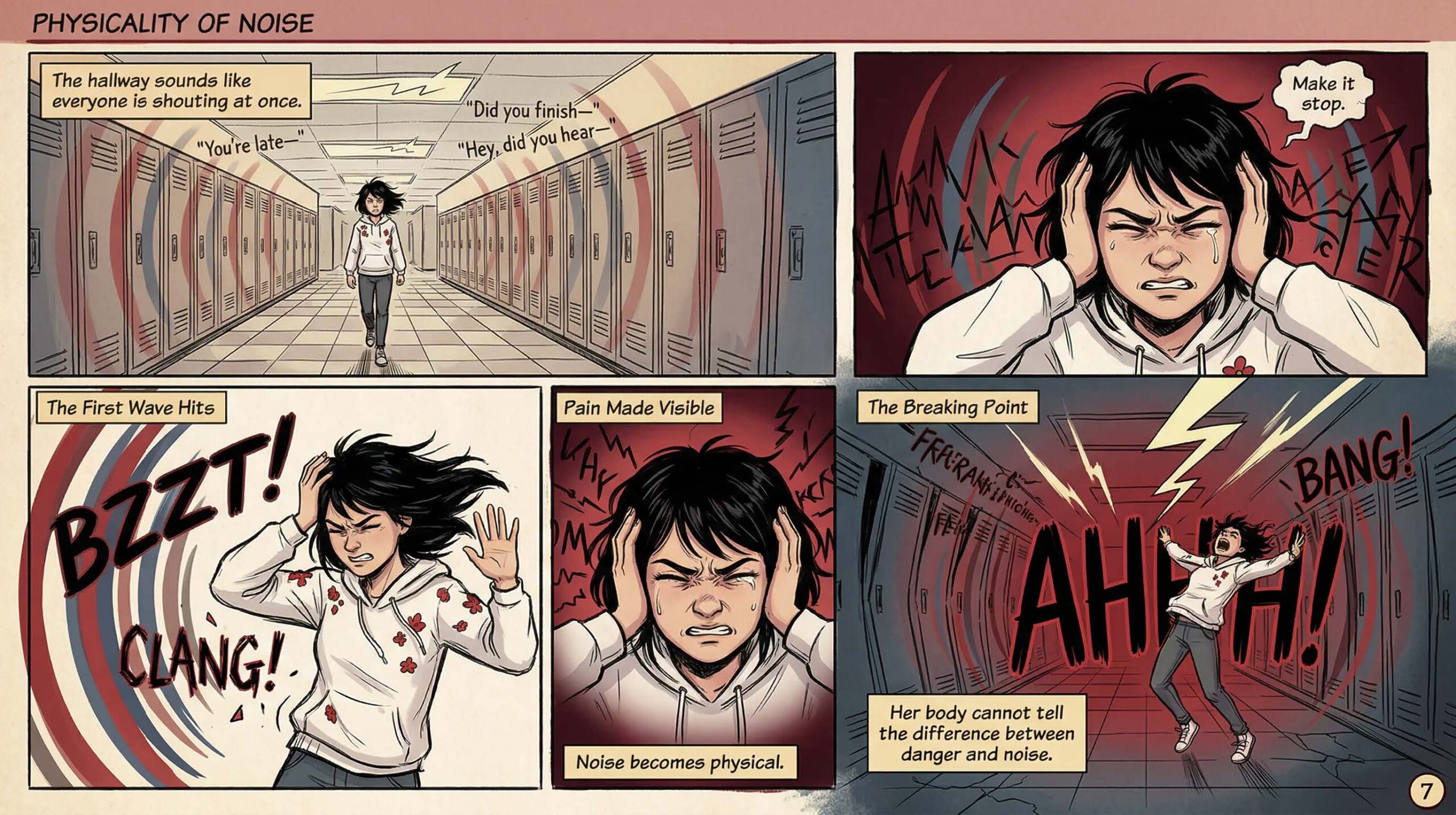
Comic page titled Physicality of Noise — showing a girl overwhelmed by hallway noise at school, covering her ears as sounds like BZZT and CLANG hit her physically, with caption Her body cannot tell the difference between danger and noise — illustrates auditory sensory overload in neurodivergent girls
Auditory overload in the hallway.
Comic page titled Sensory Overload Lighting — showing a girl shielding her eyes from flickering fluorescent lights in school, panels captioned The light doesn't just hurt her eyes it hits her like a wave and Her nervous system is telling the truth — illustrates visual sensory sensitivity in neurodivergent girls
Visual overload from fluorescent lighting.
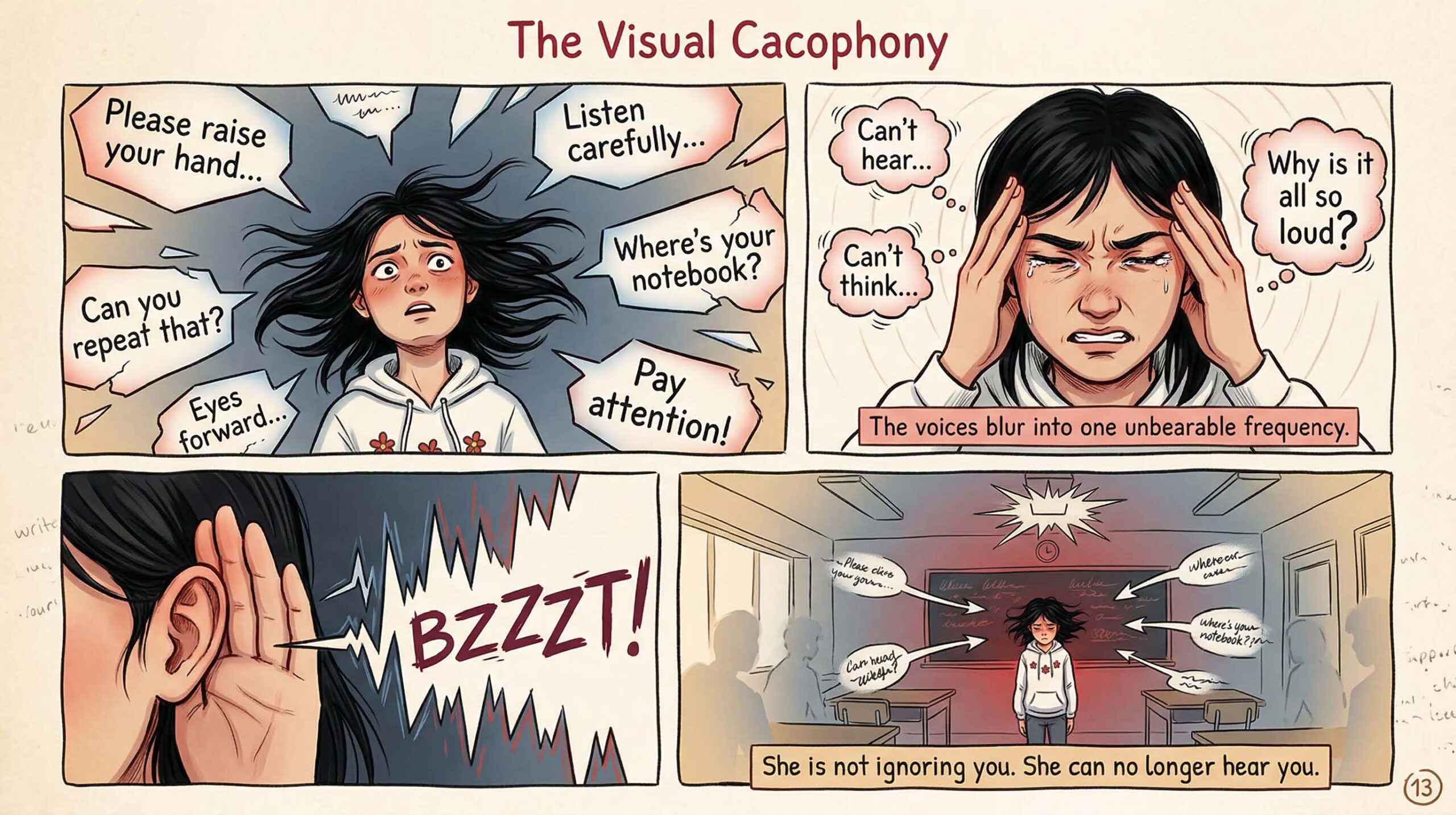
Comic page titled The Visual Cacophony — a girl surrounded by overlapping teacher instructions and classroom noise, with panels showing her covering her ears and crying, captioned She is not ignoring you She can no longer hear you — depicts auditory and cognitive overload in a neurodivergent student during class
“She is not ignoring you. She can no longer hear you.”

Pages 9 to 11: Impulsivity, eruption, and the flight response

For many educators, pages 9 to 11 will be the most practically useful in the entire comic. They show, in precise sequential detail, the gap between stimulus and response in a nervous system in overdrive. The girl does not choose to yell. She does not choose to run. Her body moves faster than her conscious mind can intervene.

Understanding this gap is essential for de-escalation. It also has direct implications for how schools should respond to impulsive outbursts and elopement: these are not willful behaviors. They are physiological ones.
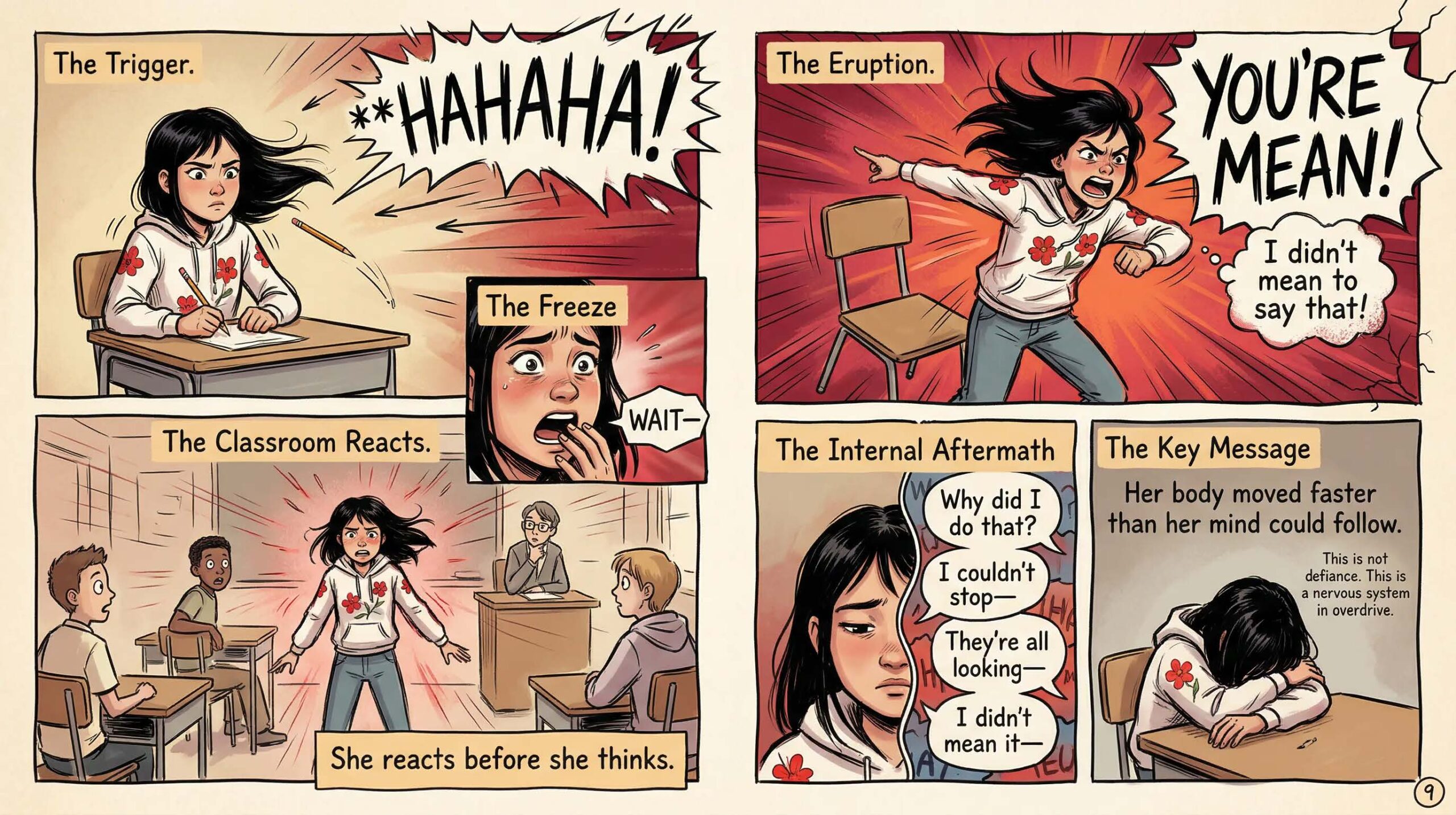
Comic page showing a girl reacting impulsively by yelling You're mean after being triggered by classroom laughter, followed by internal regret — captioned She reacts before she thinks and This is not defiance this is a nervous system in overdrive — illustrates impulsivity in neurodivergent girls with emotional overload
The eruption and its immediate internal aftermath.
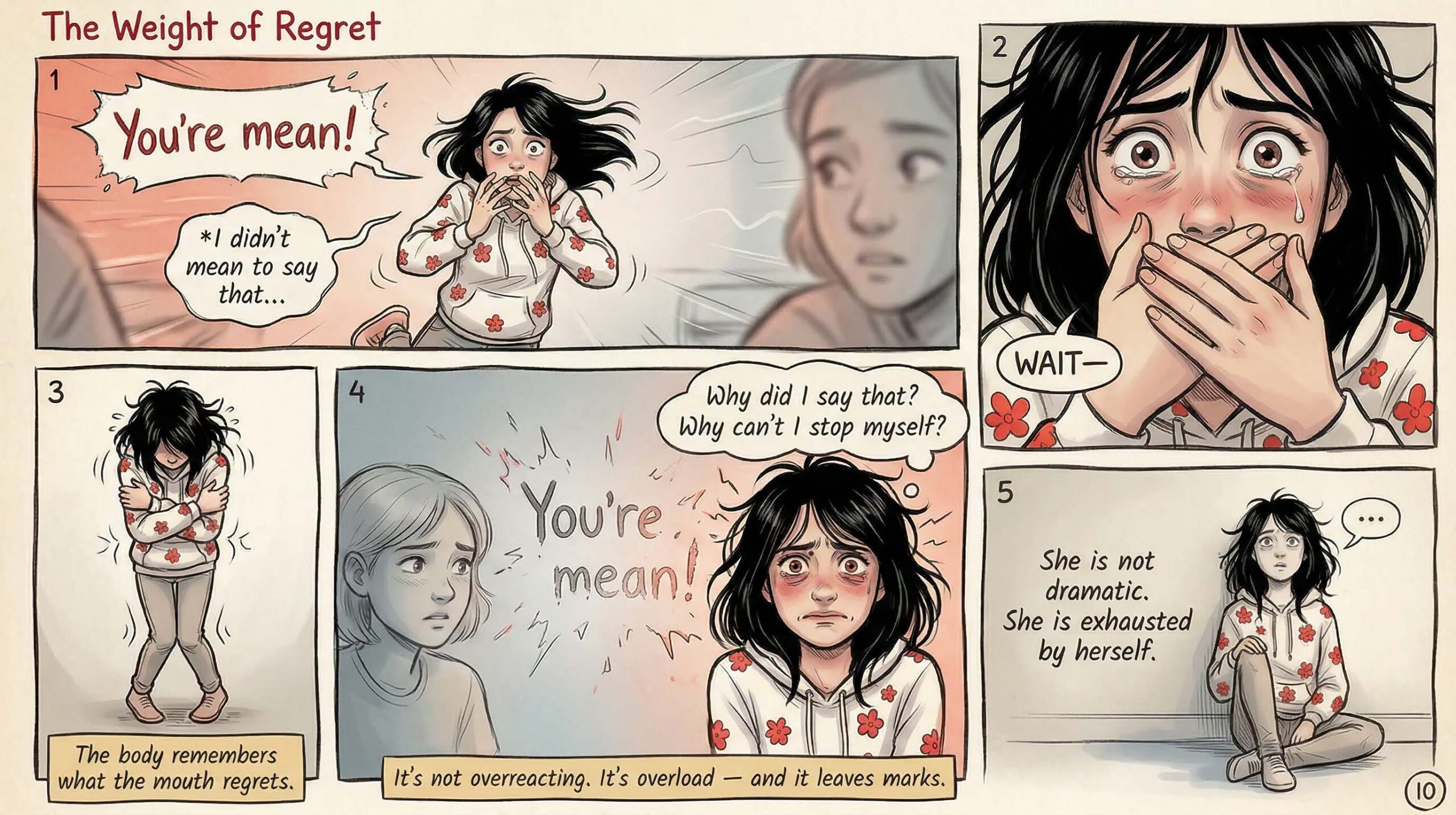
Five-panel comic titled The Weight of Regret — a neurodivergent girl covers her mouth in shock after blurting out You're mean, then hugs herself trembling, thinking Why did I say that — captioned She is not dramatic She is exhausted by herself — shows post-meltdown shame in girls with emotional dysregulation
The weight of regret that follows is real, and often overlooked by support systems.
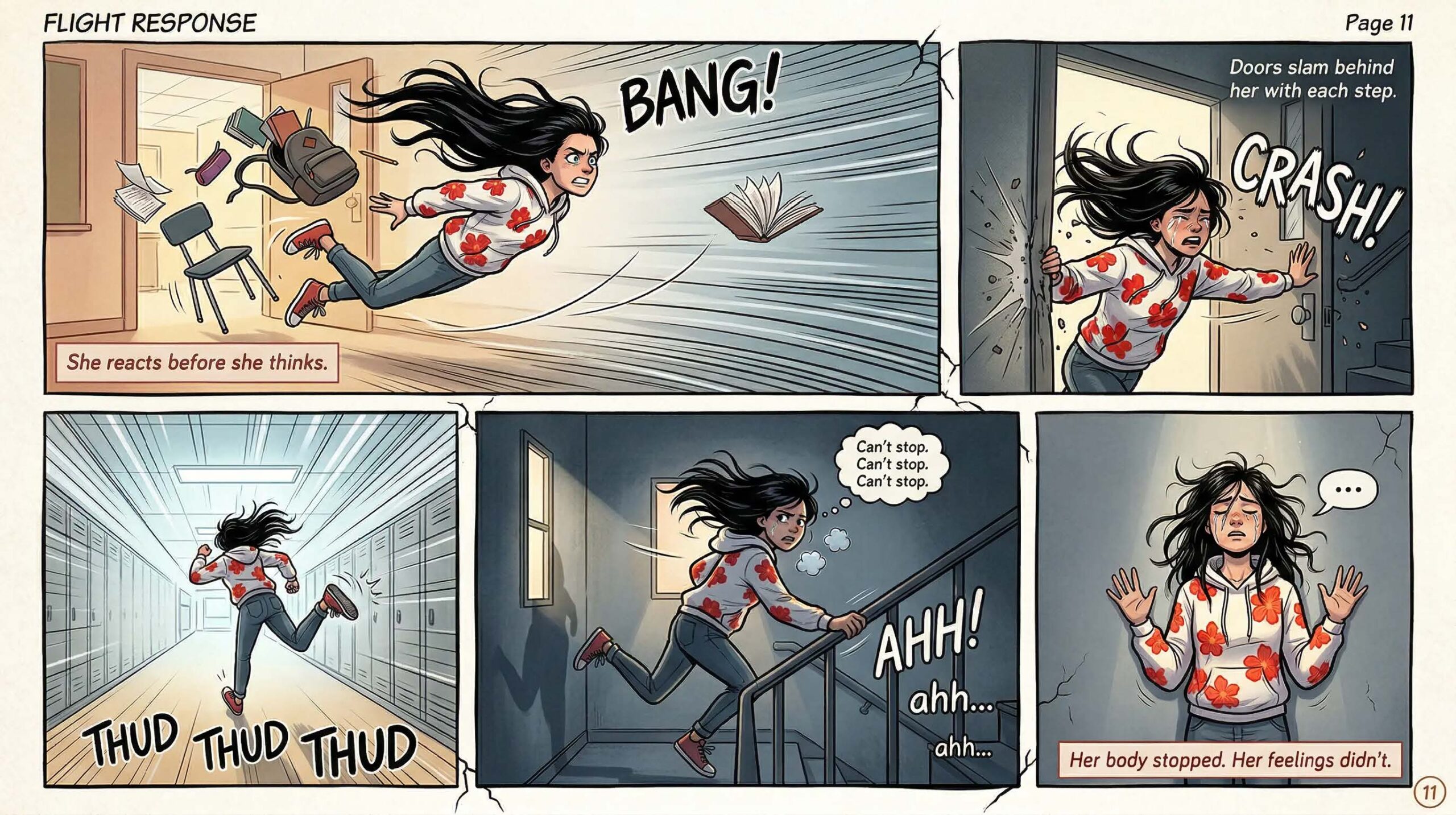
Comic page titled Flight Response — six panels showing a girl bolting from the classroom, slamming doors, running through hallways, captioned She reacts before she thinks and Her body stopped Her feelings didn't — illustrates the fight-flight response during emotional overload in neurodivergent middle school girls
Elopement as a flight response, not defiance. The body chose to run before the mind could stop it.

Page 14: Shattered focus and cognitive fragmentation
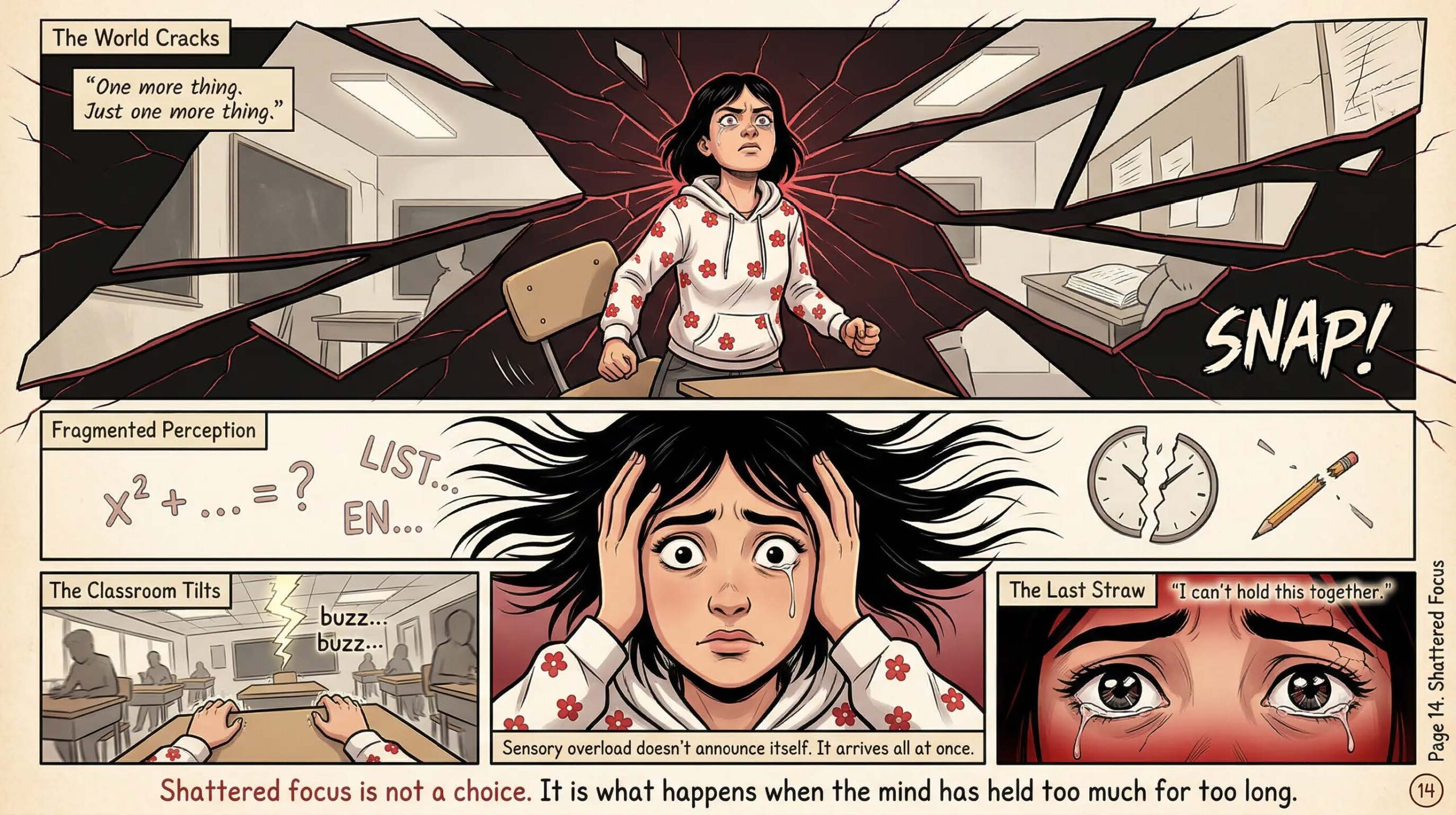
Comic page titled Shattered Focus — a girl stands at her desk as the classroom cracks and shatters around her with SNAP, panels show fragmented math equations, a broken clock, and close-up of tearful eyes, captioned Shattered focus is not a choice it is what happens when the mind has held too much for too long
“Shattered focus is not a choice. It is what happens when the mind has held too much for too long.” This page is essential reading for any educator questioning why a previously focused student suddenly cannot process instruction.

Pages 15 to 17: The adult perspective, peer judgment, and invisibility

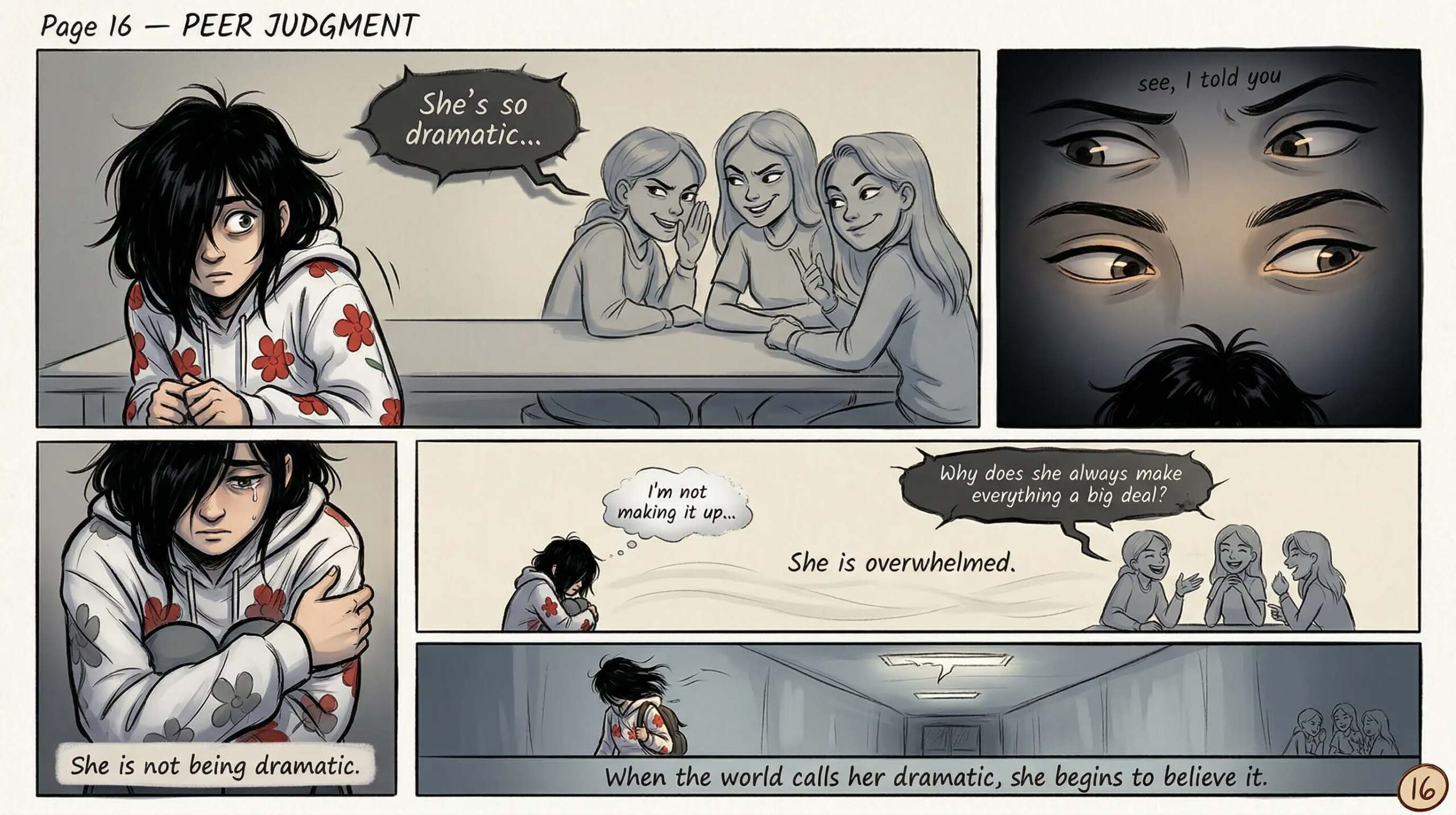
These three pages address the social dimension of emotional overload with particular clarity. Page 15 shows an educator responding with “calm down, you’re overreacting” — not from cruelty, but from the same misunderstanding that this entire comic exists to correct. Page 16 shows how peer reactions layer shame onto an already overwhelmed nervous system. Page 17 shows perhaps the most dangerous outcome: the child who carries the storm entirely alone because no adult has learned to see it.
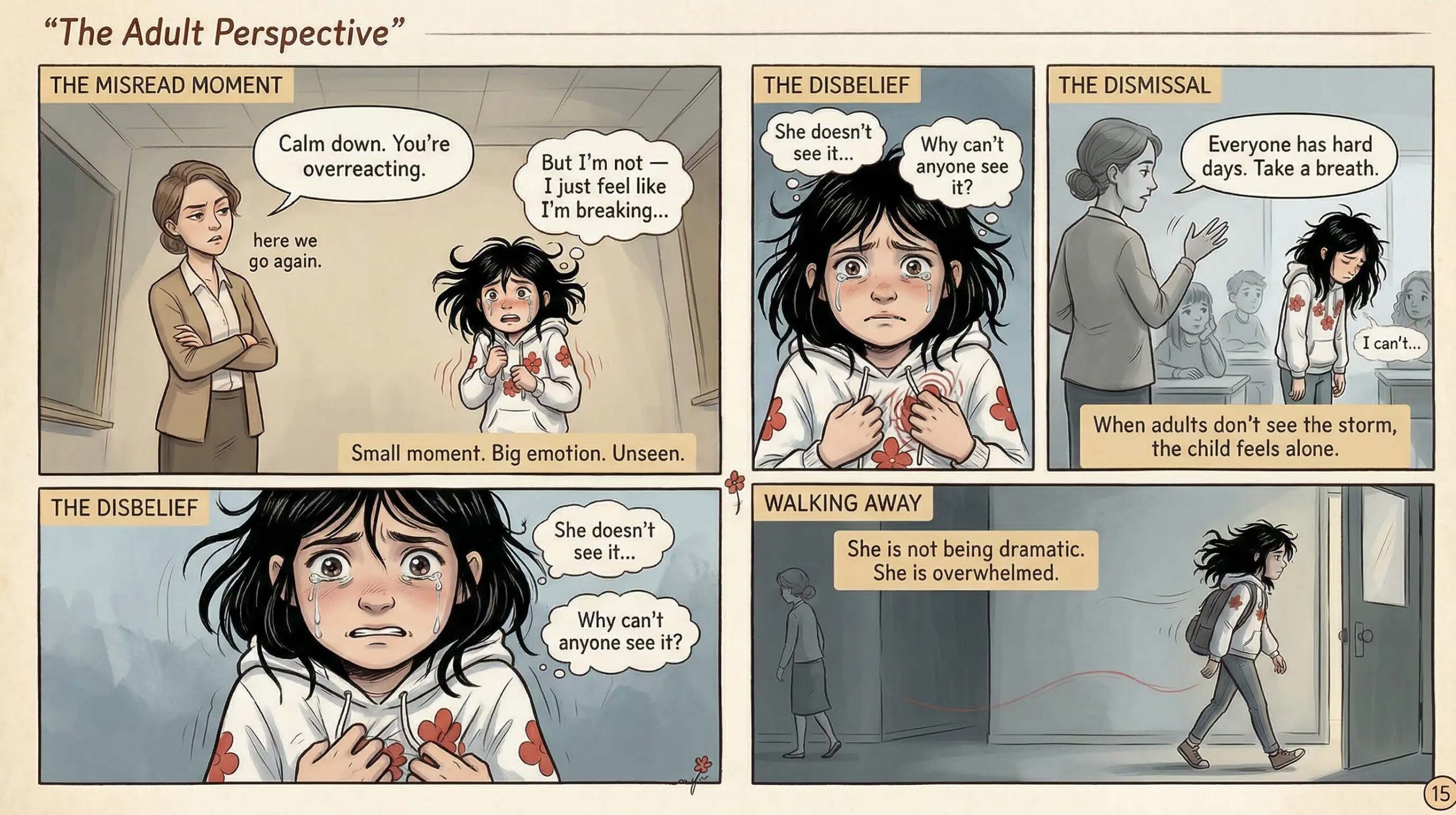
Comic page titled The Adult Perspective — four panels showing a teacher telling the girl to calm down while the girl thinks no one sees it, captioned Small Moment Big Emotion Unseen and She is not being dramatic She is overwhelmed — illustrates how adults misread emotional overload in neurodivergent girls
What the adult sees, and what the child experiences, are two entirely different realities.
Comic page titled Peer Judgment — panels showing classmates whispering She's so dramatic while the overwhelmed girl hugs herself, captioned She is not being dramatic and When the world calls her dramatic she begins to believe it — illustrates the social impact of emotional overload on neurodivergent girls
When the world calls her dramatic often enough, she begins to believe it. Social labeling compounds neurological vulnerability.
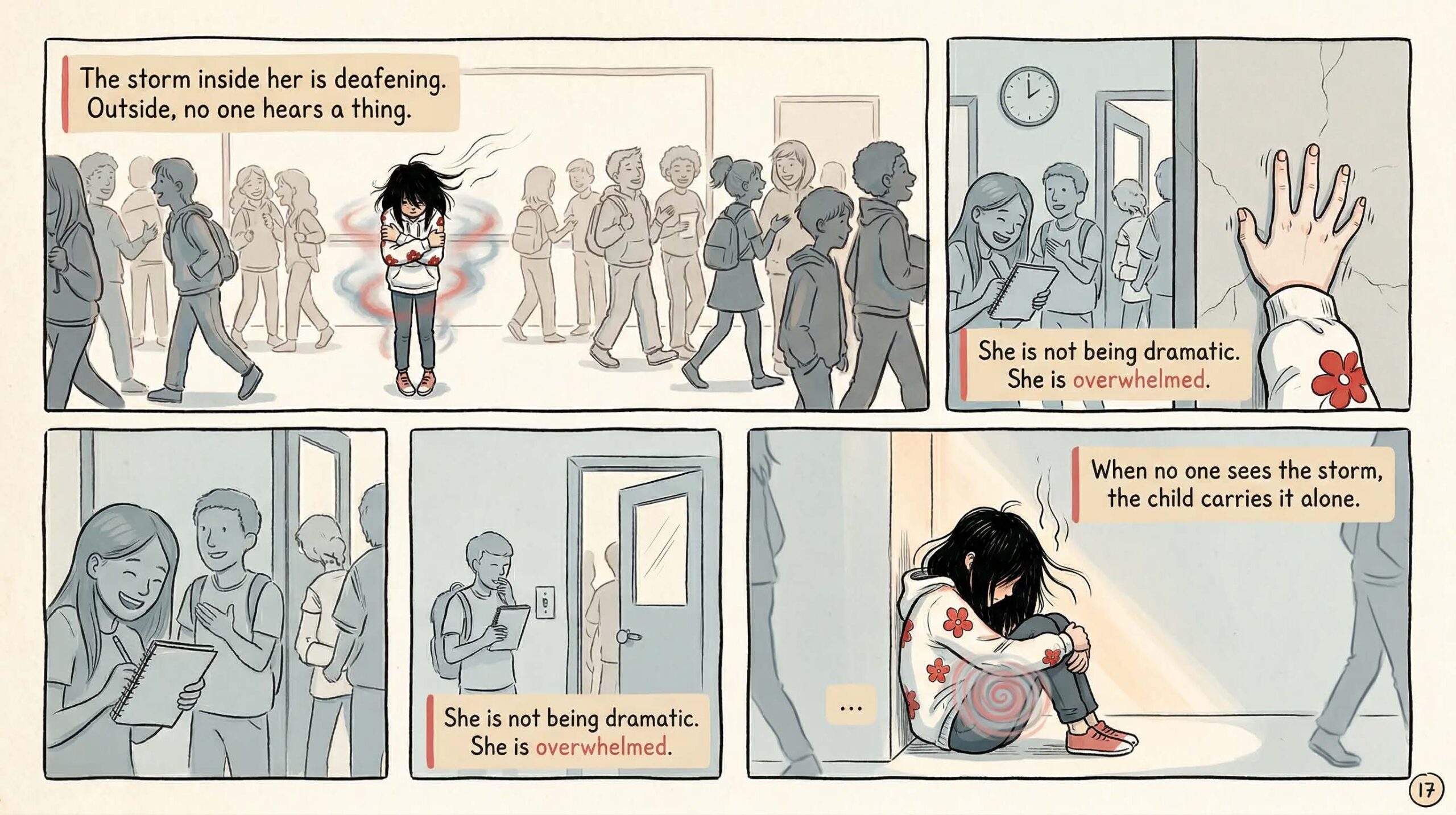
Comic page showing a neurodivergent girl frozen in a busy school hallway while classmates laugh and walk past, with caption When no one sees the storm the child carries it alone — illustrates emotional masking and internal overwhelm in neurodivergent girls at school
The hallway as a site of silent suffering. “When no one sees the storm, the child carries it alone.”

Pages 18 to 20: The racing mind, haze, and the failure of standard coping strategies

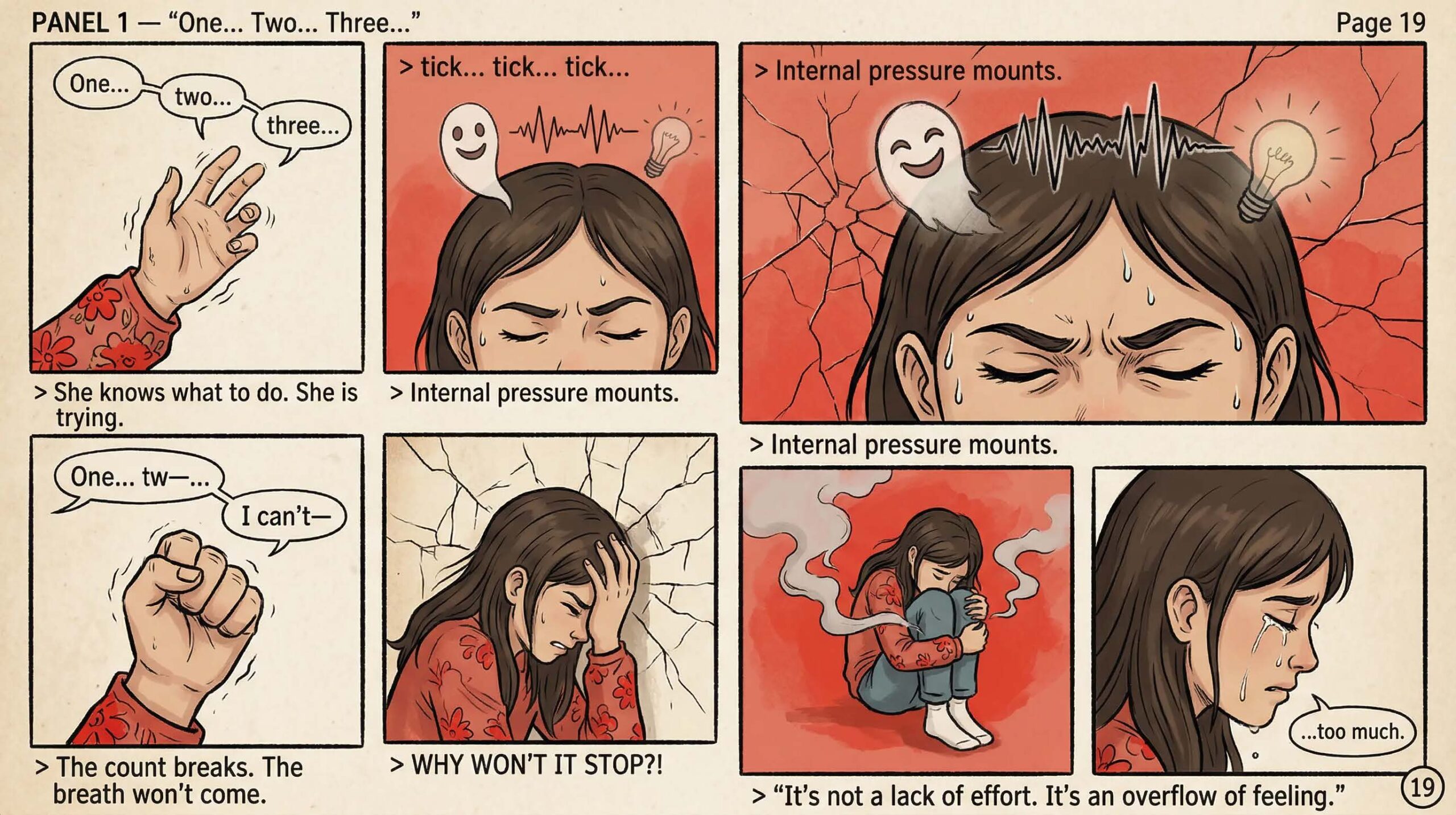
These pages are invaluable for conversations with educators who have tried breathing exercises, counting strategies, or mindfulness tools with neurodivergent girls and found them ineffective. The comic shows exactly why: when the nervous system is at full capacity, the executive function required to implement a coping strategy is the first thing that goes offline.
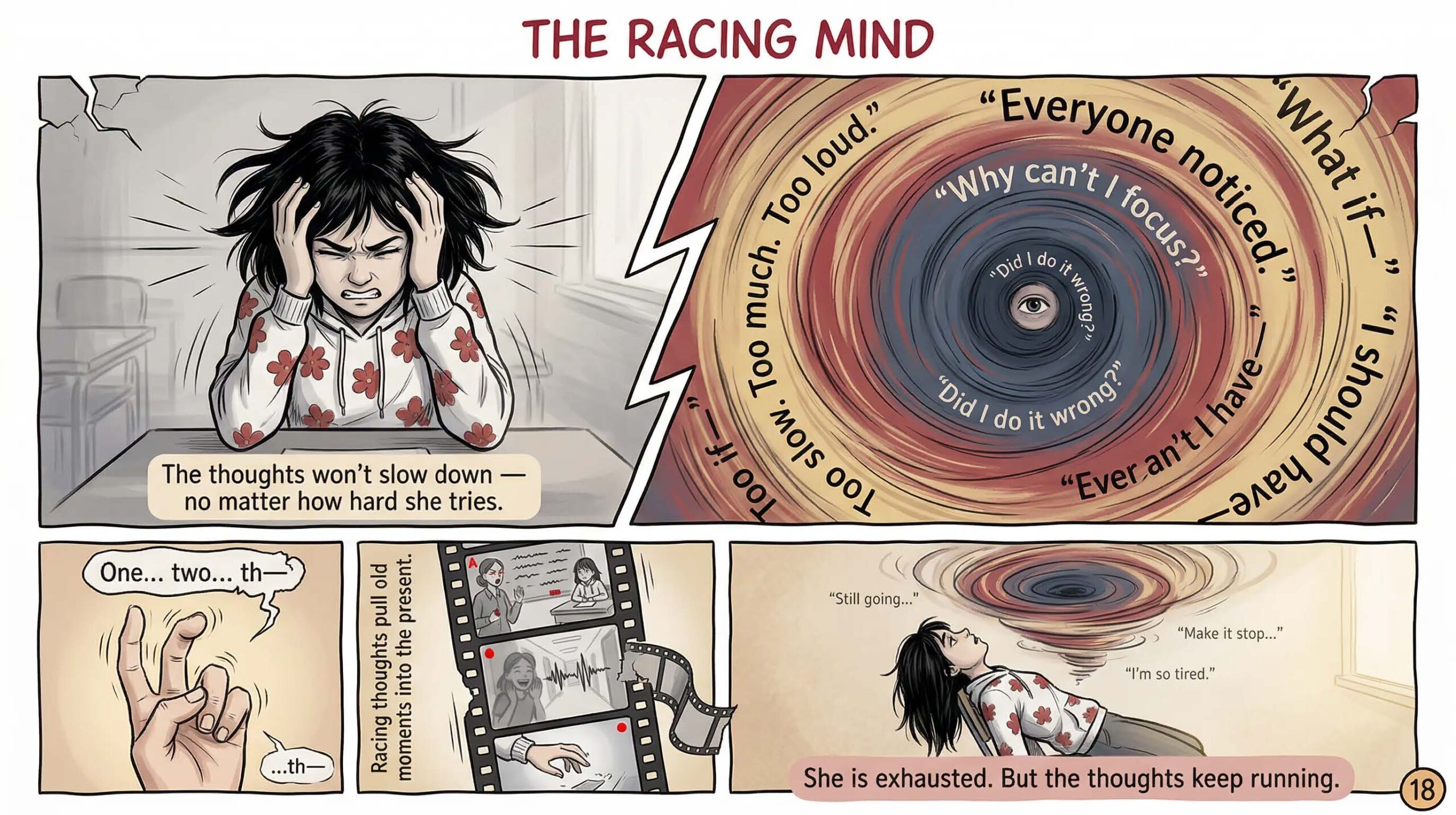
Comic page titled The Racing Mind — showing a girl gripping her head while a spiral vortex of anxious thoughts surrounds her reading Why can't I focus, Everyone noticed, Did I do it wrong — captioned She is exhausted but the thoughts keep running — illustrates racing intrusive thoughts during emotional overload in neurodivergent girls
The racing mind does not respond to logic. It responds to felt safety.
Comic page showing a girl trying to count to three as a calming strategy but failing as internal pressure builds, panels captioned She knows what to do She is trying and It's not a lack of effort It's an overflow of feeling — illustrates why standard self-regulation strategies can fail during emotional overload
“It’s not a lack of effort. It’s an overflow of feeling.” This distinction should inform every regulation plan written for neurodivergent girls.
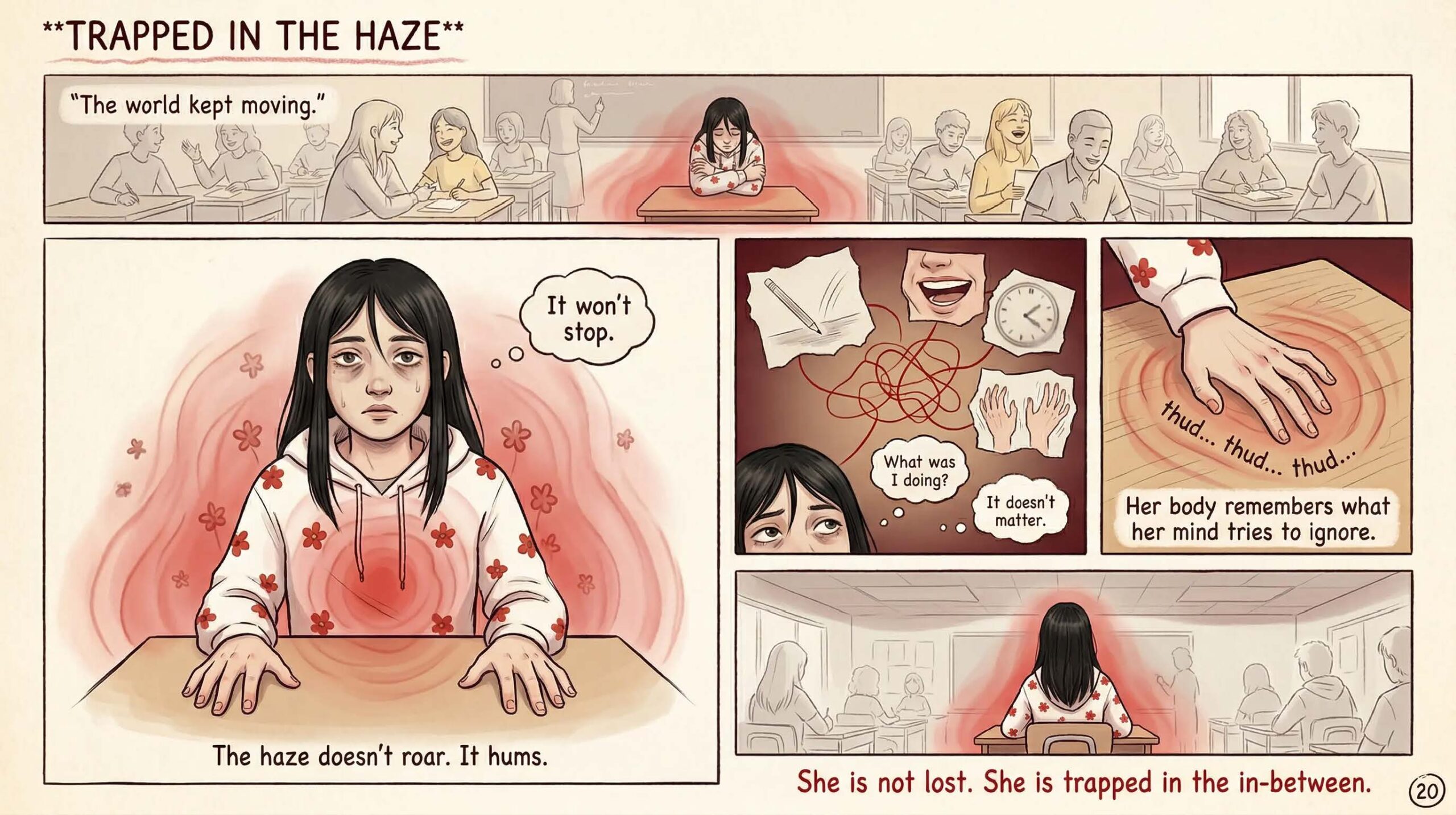
Comic page titled Trapped in the Haze — showing a neurodivergent girl sitting at her desk in a dissociated state while the classroom continues around her, captioned The haze doesn't roar It hums and She is not lost She is trapped in the in-between — illustrates emotional shutdown and dissociation in girls with neurodivergent profiles
Emotional shutdown looks like compliance. It is not. “She is not lost. She is trapped in the in-between.”

Pages 21 to 23: Masking, the broken mirror, and the escape

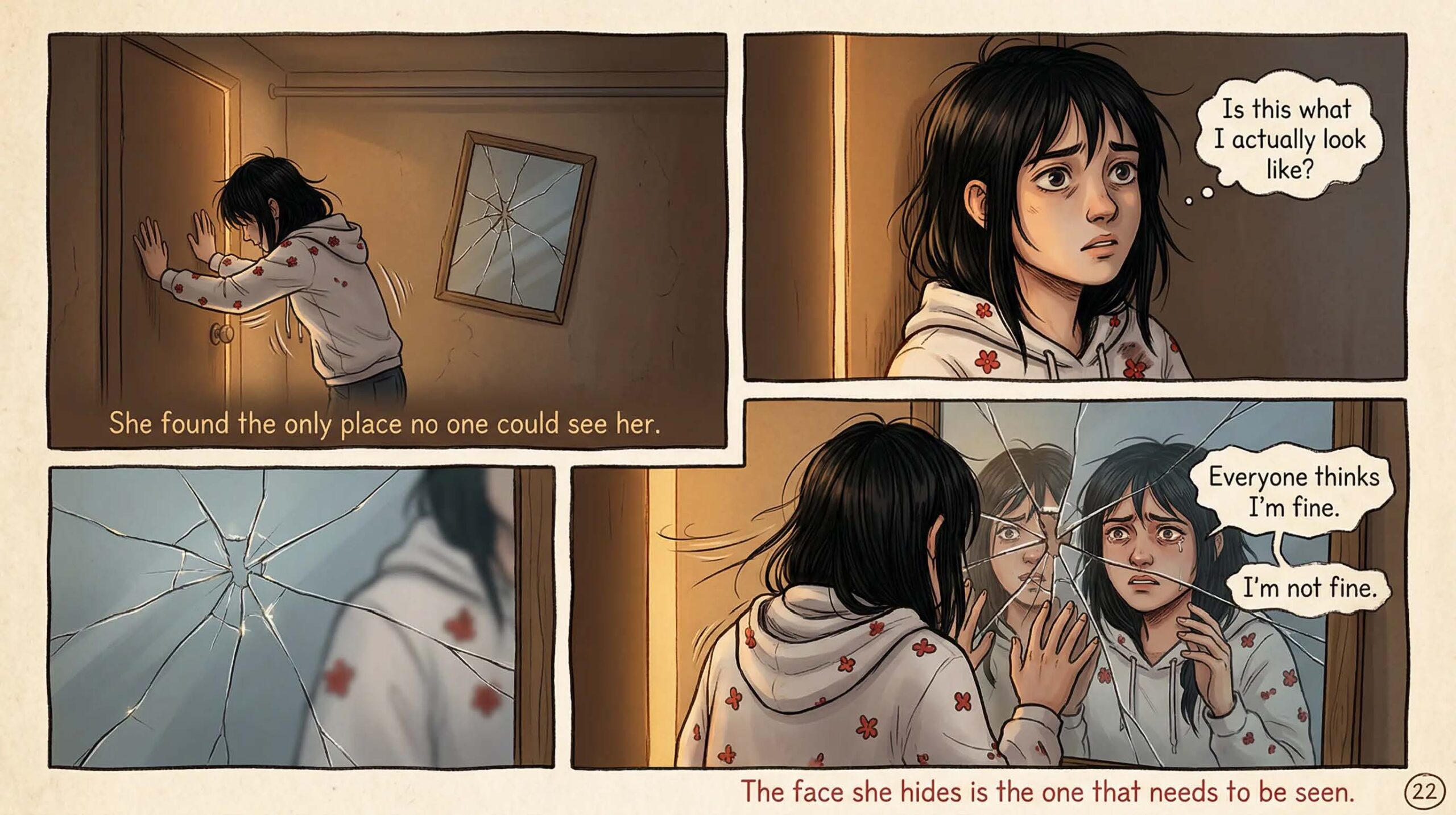
The masking section may be the most important for parents of girls who present as “fine” at school and fall apart at home. Pages 21 and 22 document the energetic cost of performing normalcy all day, and the private collapse that follows. Page 23 shows the body-led escape that others misread as rudeness or defiance.
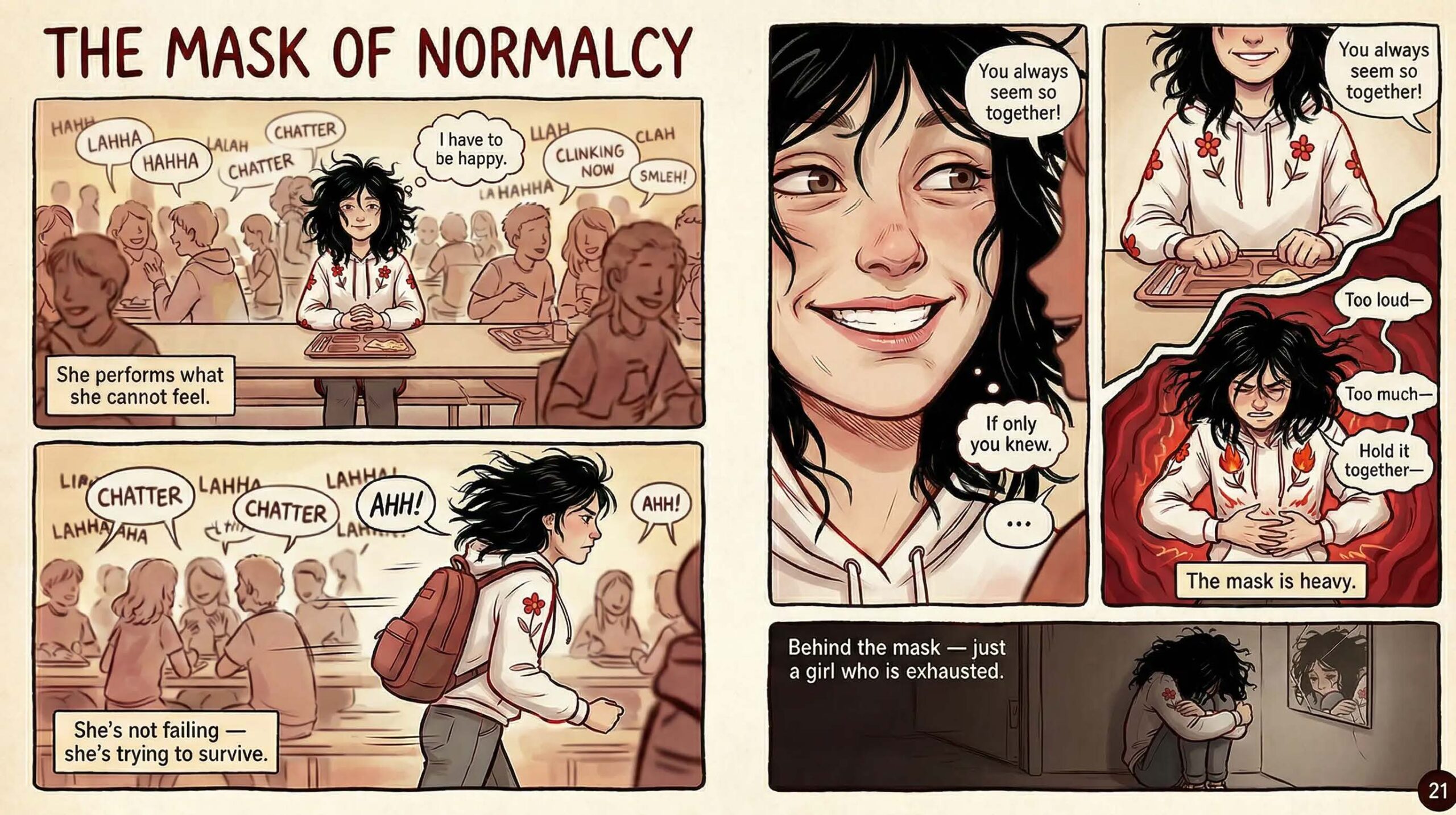
Comic page titled The Mask of Normalcy — a girl smiling in the cafeteria while internally overwhelmed, split panels show her composed face and her raging inner world, captioned She performs what she cannot feel and Behind the mask just a girl who is exhausted — illustrates emotional masking in neurodivergent girls
The cafeteria smile costs more than anyone watching can see.
Comic page showing a neurodivergent girl slipping into a bathroom to hide, staring at herself in a cracked mirror thinking Is this what I actually look like and Everyone thinks I'm fine I'm not fine — captioned The face she hides is the one that needs to be seen — illustrates internalized shame after emotional overload
The cracked mirror reflects how she actually experiences herself when the mask comes off.
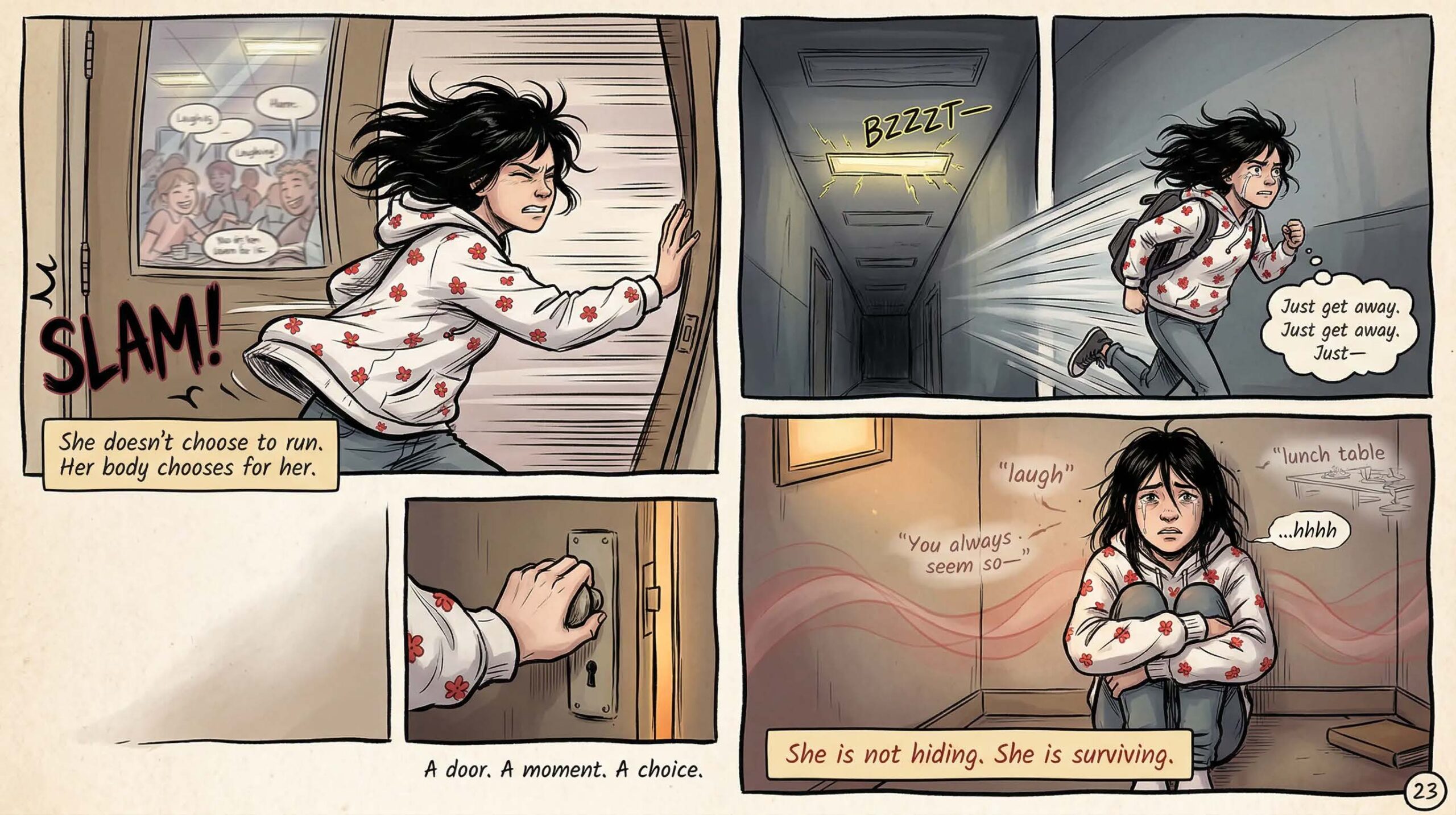
Comic page showing a girl slamming the classroom door and running down a school hallway under buzzing lights, thinking Just get away, then curled against a wall in a corner captioned She is not hiding She is surviving — illustrates avoidance and flight response during emotional overload in neurodivergent girls
“She doesn’t choose to run. Her body chooses for her.” — and then: “She is not hiding. She is surviving.”

Pages 24 and 25: The aftermath and the echo of silence
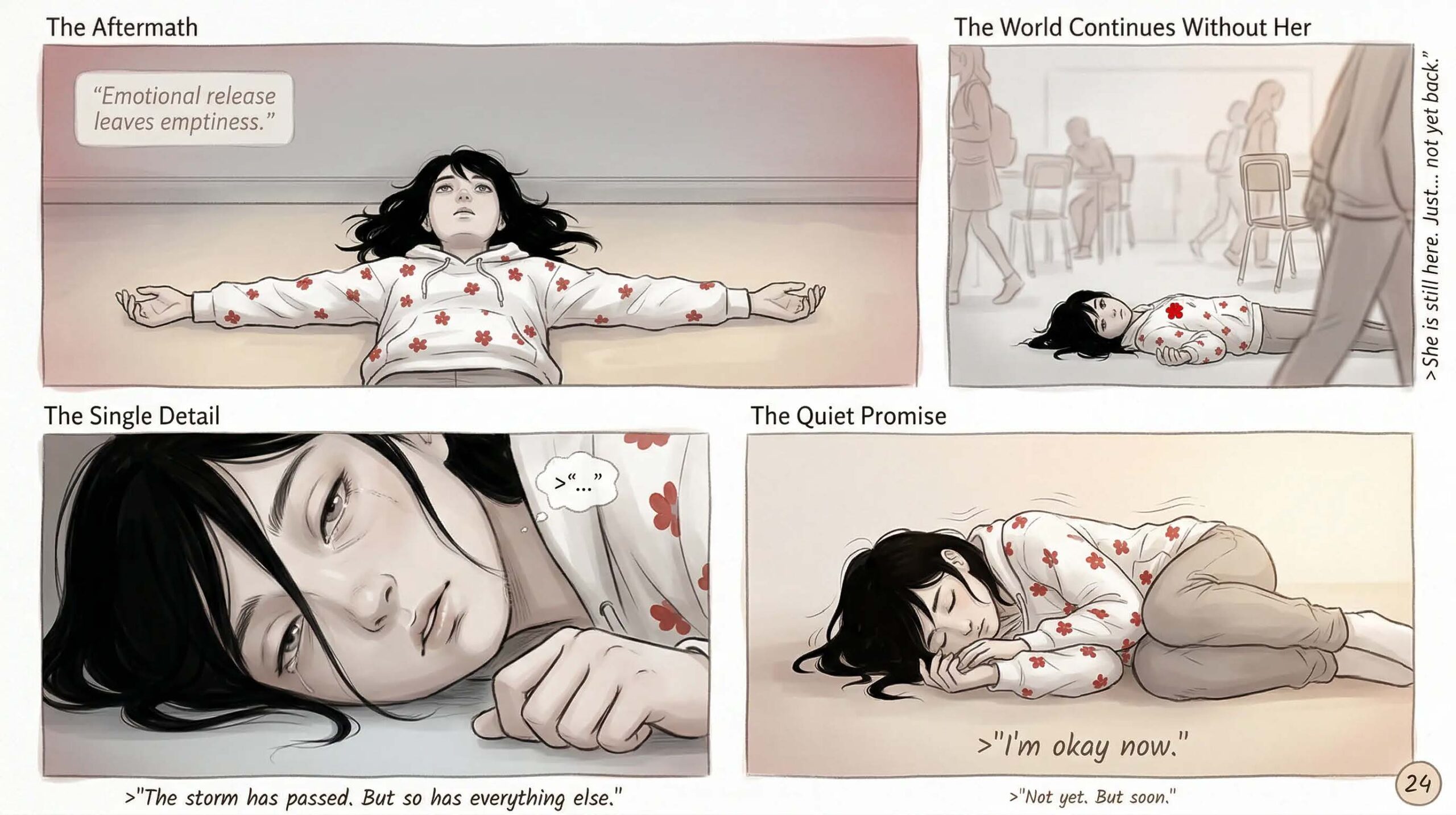
Four-panel comic page titled The Aftermath — a girl lies on the floor empty and still after an emotional meltdown, captioned Emotional release leaves emptiness and The storm has passed but so has everything else — illustrates post-meltdown emotional exhaustion in neurodivergent girls
Post-meltdown exhaustion is physiological, not theatrical. “The storm has passed. But so has everything else.”
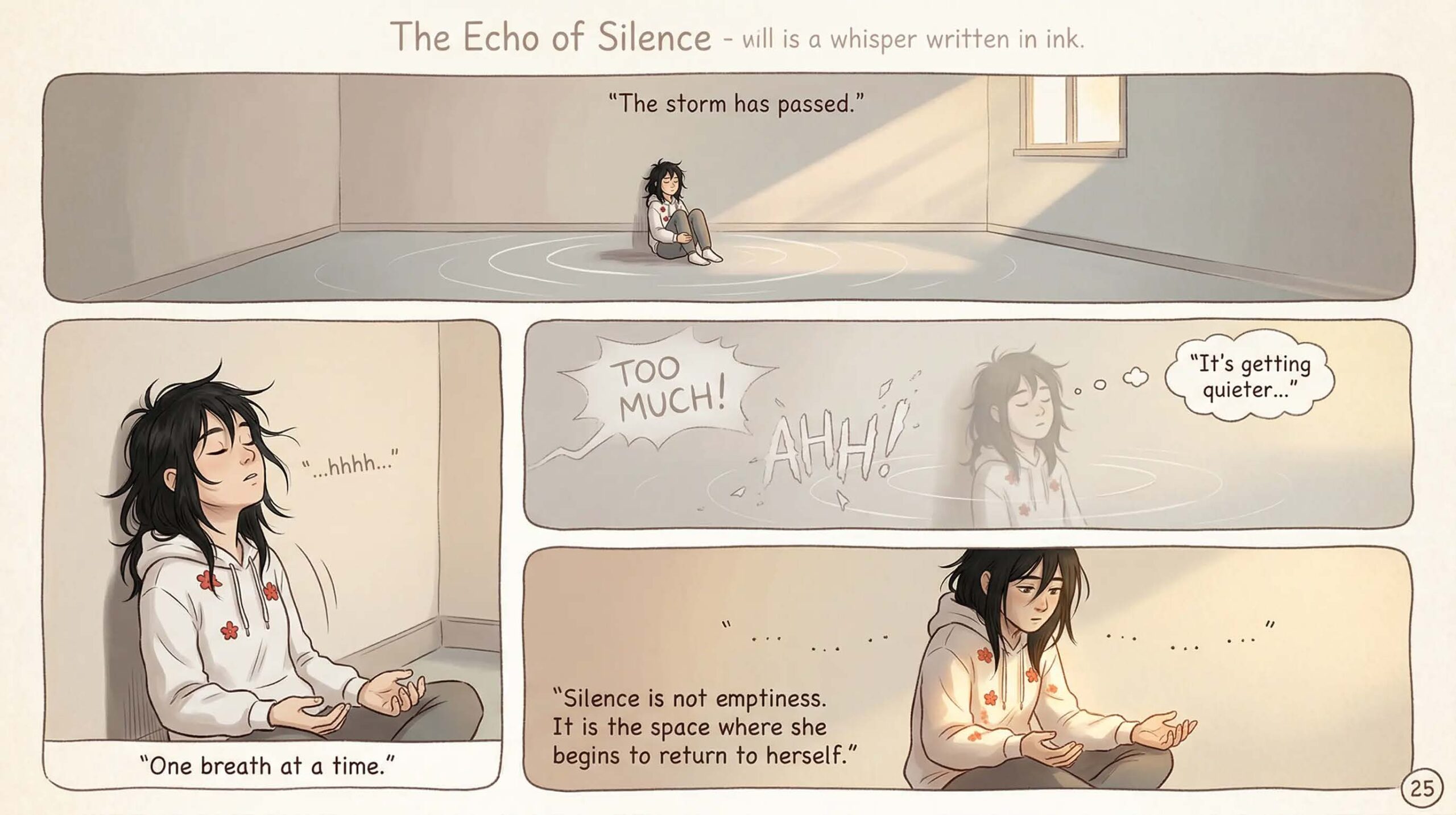
Comic page titled The Echo of Silence — a girl sits alone in a quiet room breathing deeply, with faded echoes of Too Much and Ahh dissolving around her, captioned Silence is not emptiness It is the space where she begins to return to herself — illustrates the calm-down phase after emotional overload
“Silence is not emptiness. It is the space where she begins to return to herself.” This reframe matters for educators who interpret post-meltdown quiet as sulking.

In Class
How to use this comic with students

The comic’s greatest classroom strength is its capacity to open conversations that students cannot initiate verbally. Below are concrete applications organized by purpose.

Pages 26 to 29: Co-regulation, validation, and giving space

The support section of the comic is not just for students. It is a training module for adults. Pages 26 through 29 model four distinct support skills: showing up without fixing, validating without permitting, giving space without abandoning, and waiting without pressuring. Each one has an evidence base in trauma-informed and neuroaffirmative practice.
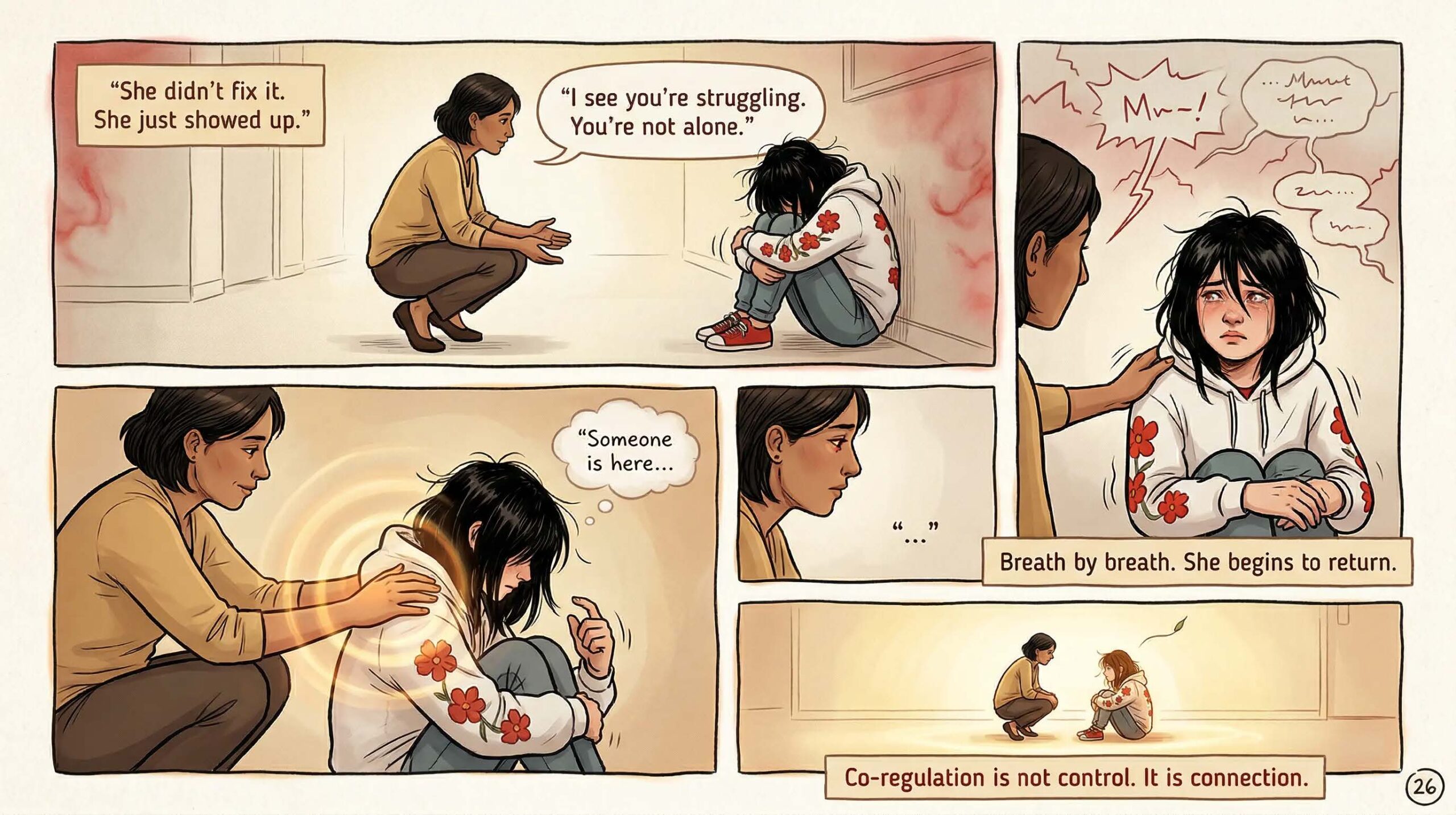
Comic page showing a caring adult crouching beside an overwhelmed girl curled on the floor, saying I see you're struggling you're not alone, then gently placing a hand on her shoulder, captioned Co-regulation is not control It is connection — illustrates co-regulation support strategies for neurodivergent students during emotional overload
“Co-regulation is not control. It is connection.” A calm adult nervous system is the most powerful regulation tool available to a dysregulated child.
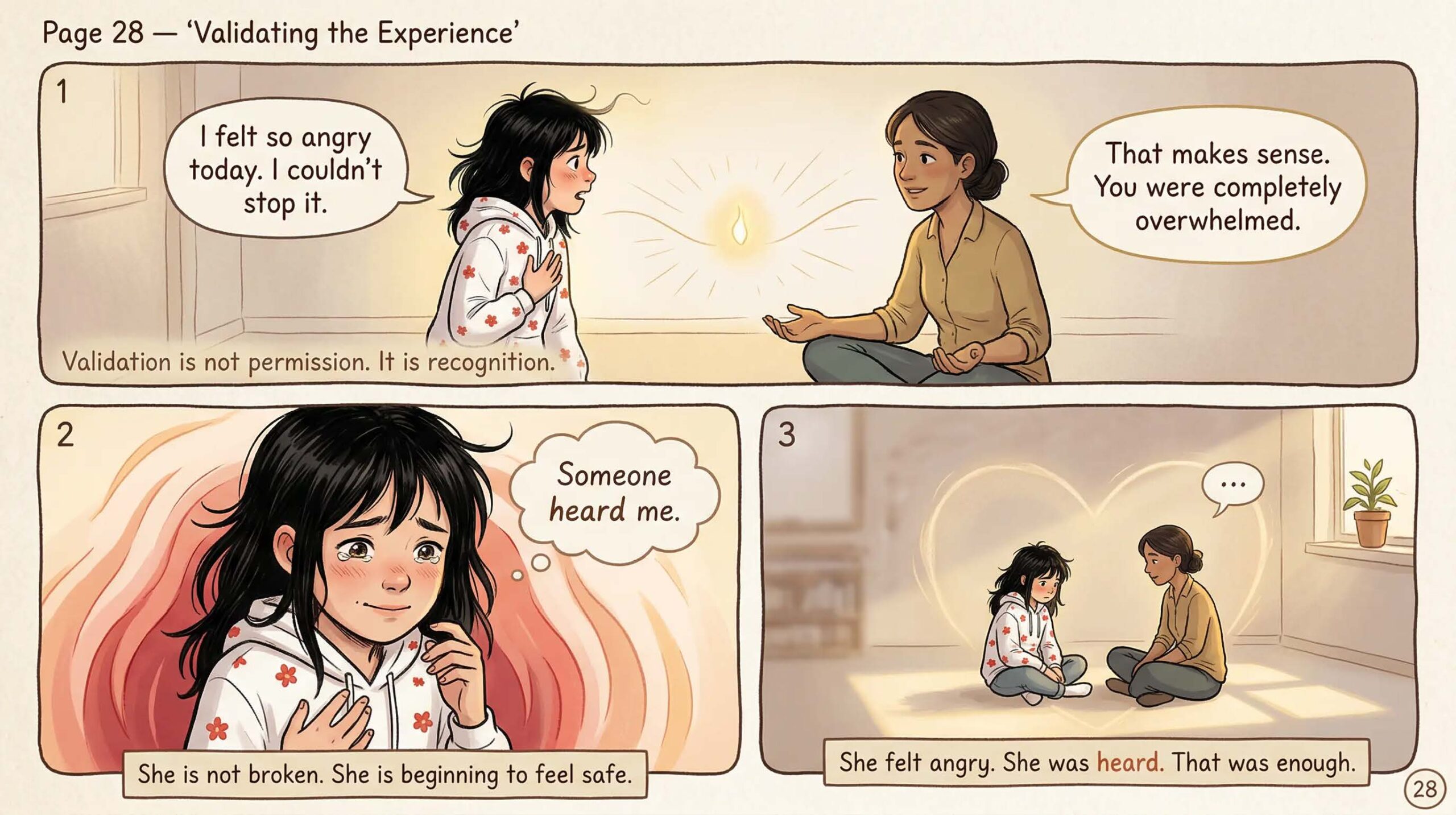
Three-panel comic page titled Validating the Experience — a girl tells a supportive adult I felt so angry today I couldn't stop it and the adult responds That makes sense you were completely overwhelmed, captioned Validation is not permission It is recognition and She felt angry She was heard That was enough
“Validation is not permission. It is recognition.” This page is ideal for role-play practice in professional development.
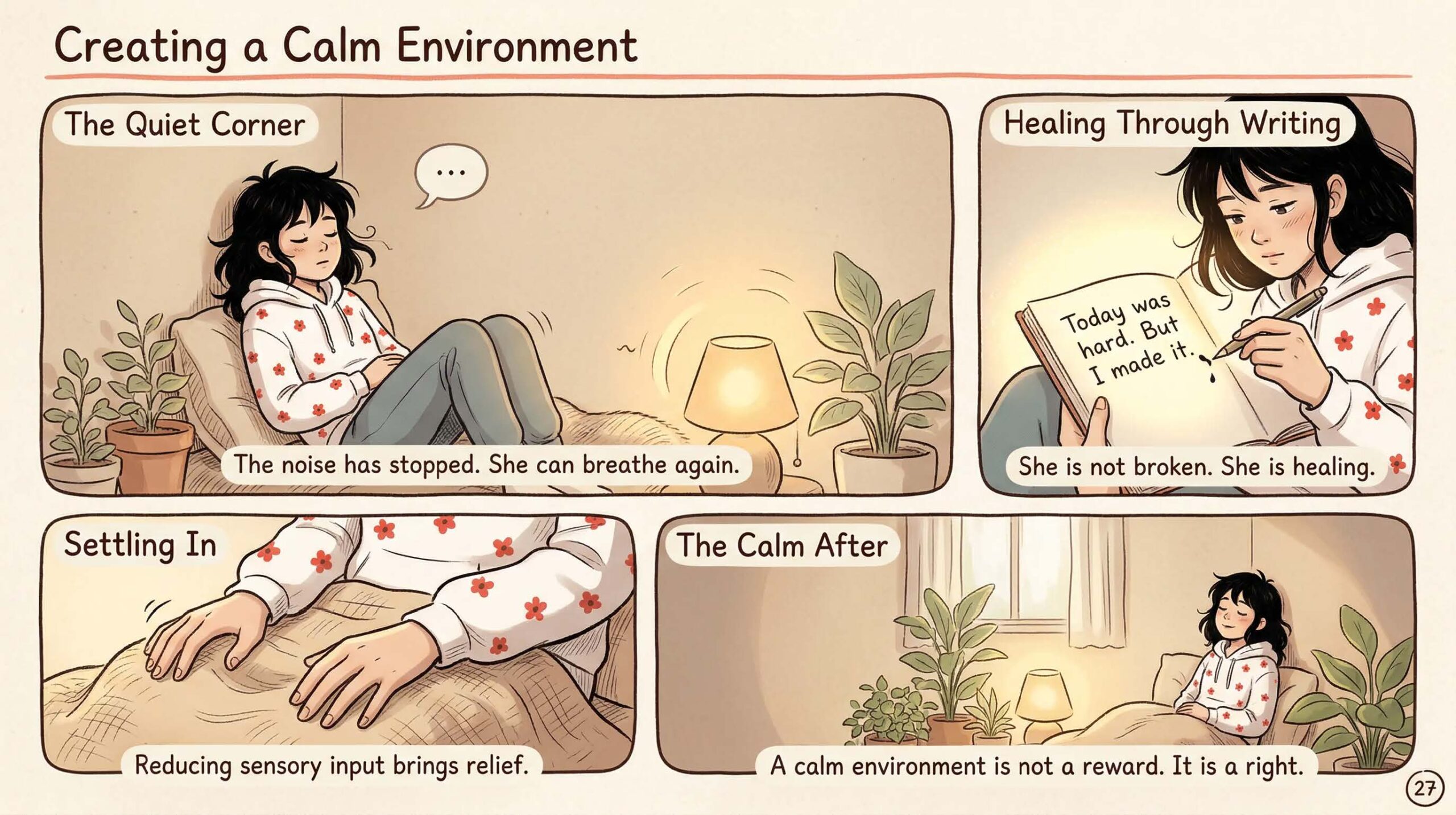
Comic page titled Creating a Calm Environment — four panels showing a neurodivergent girl resting in a cozy quiet corner with plants, writing in a journal Today was hard but I made it, captioned A calm environment is not a reward It is a right — illustrates sensory-safe spaces and journaling as emotional regulation supports for neurodivergent girls
“A calm environment is not a reward. It is a right.” This page directly supports sensory accommodation requests in IEP meetings.
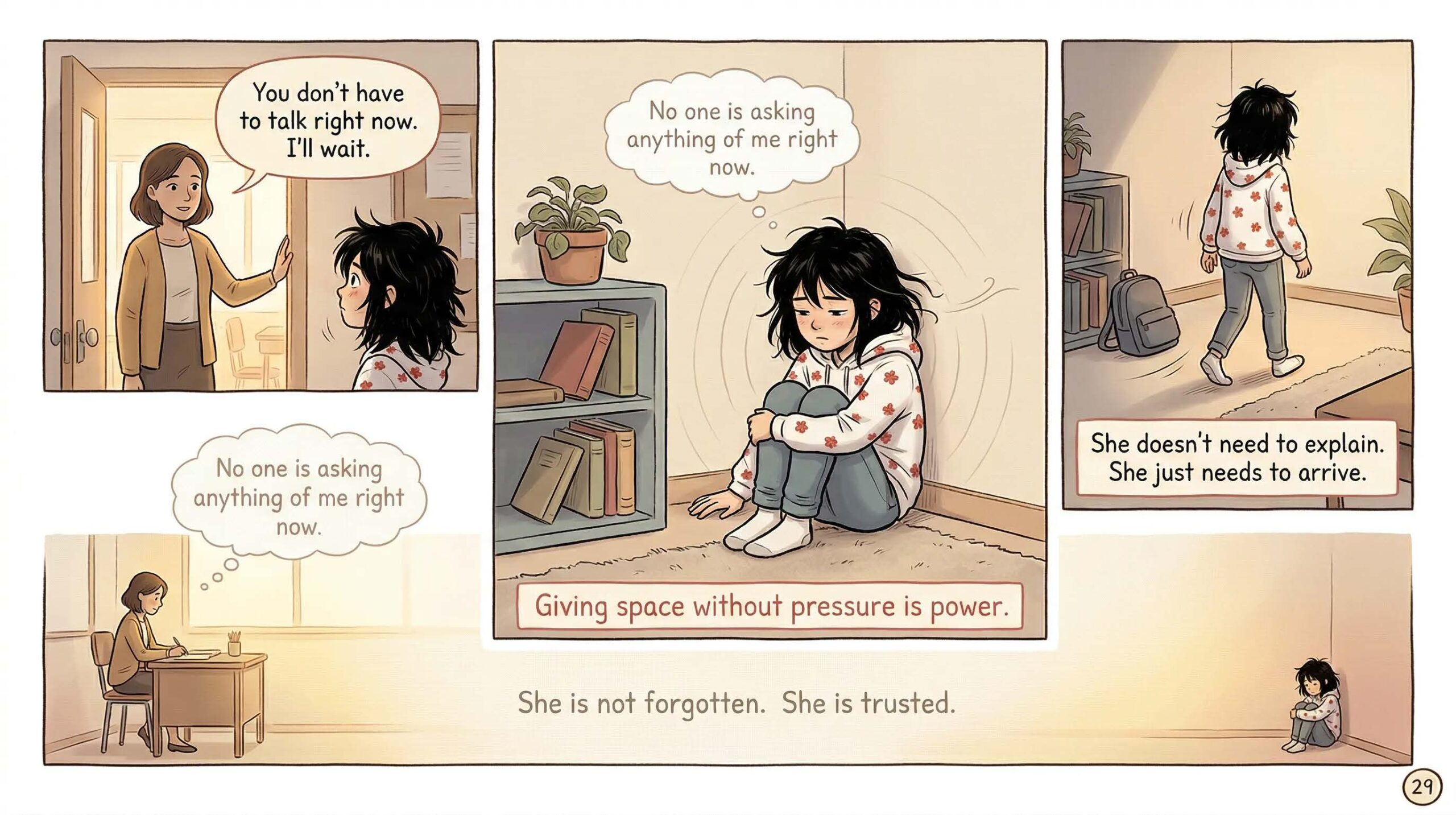
Comic page showing a supportive adult saying You don't have to talk right now I'll wait, while a neurodivergent girl sits in a reading corner feeling the pressure lift, captioned Giving space without pressure is power and She is not forgotten She is trusted — illustrates low-demand support strategies for students with emotional overload
“She is not forgotten. She is trusted.” Low-demand presence is one of the most underused tools in special education.
Faites défiler pour voir tout le tableau
Comic pagesClassroom applicationStudent age rangeFormat
Pages 3 to 5Introduce the concept of triggers vs. accumulated overloadAges 10 and upWhole class discussion or small group
Pages 6 to 8Identify personal early warning signs with a body map activityAges 9 and upIndividual reflection with adult support
Pages 9 to 10Discuss impulsivity without shame; normalize the regret cycleAges 11 and upSmall group, counselor-led
Pages 12 to 13Sensory audit of the classroom; student-identified triggersAll agesVisual checklist activity
Pages 15 to 16Perspective-taking: what does each character feel?Ages 10 and upPaired or small group discussion
Pages 21 to 22Introduce masking; validate the energy cost of performing normalcyAges 12 and up1:1 counselor or trusted adult
Pages 26 to 29Model and practice co-regulation scripts with staffStaff PDRole-play in pairs

At Home
How parents can use this comic together

For parents, the comic works best as a shared reading experience rather than an instructional one. The goal is not to explain what their daughter is doing wrong, but to show her that someone has seen what she goes through accurately, without judgment, and without asking her to change who she is.

Pages 30 and 31: Recovery and the perspective shift

Comic page titled Gradual Recovery — four panels showing a neurodivergent girl taking her first deep breath, sitting with a supportive adult, then reading quietly, captioned Recovery is not the absence of feeling It is learning to hold it — illustrates the gradual recovery process after emotional overload in girls
“Recovery is not the absence of feeling. It is learning to hold it.” This redefines what success looks like for families who have been measuring the wrong outcome.
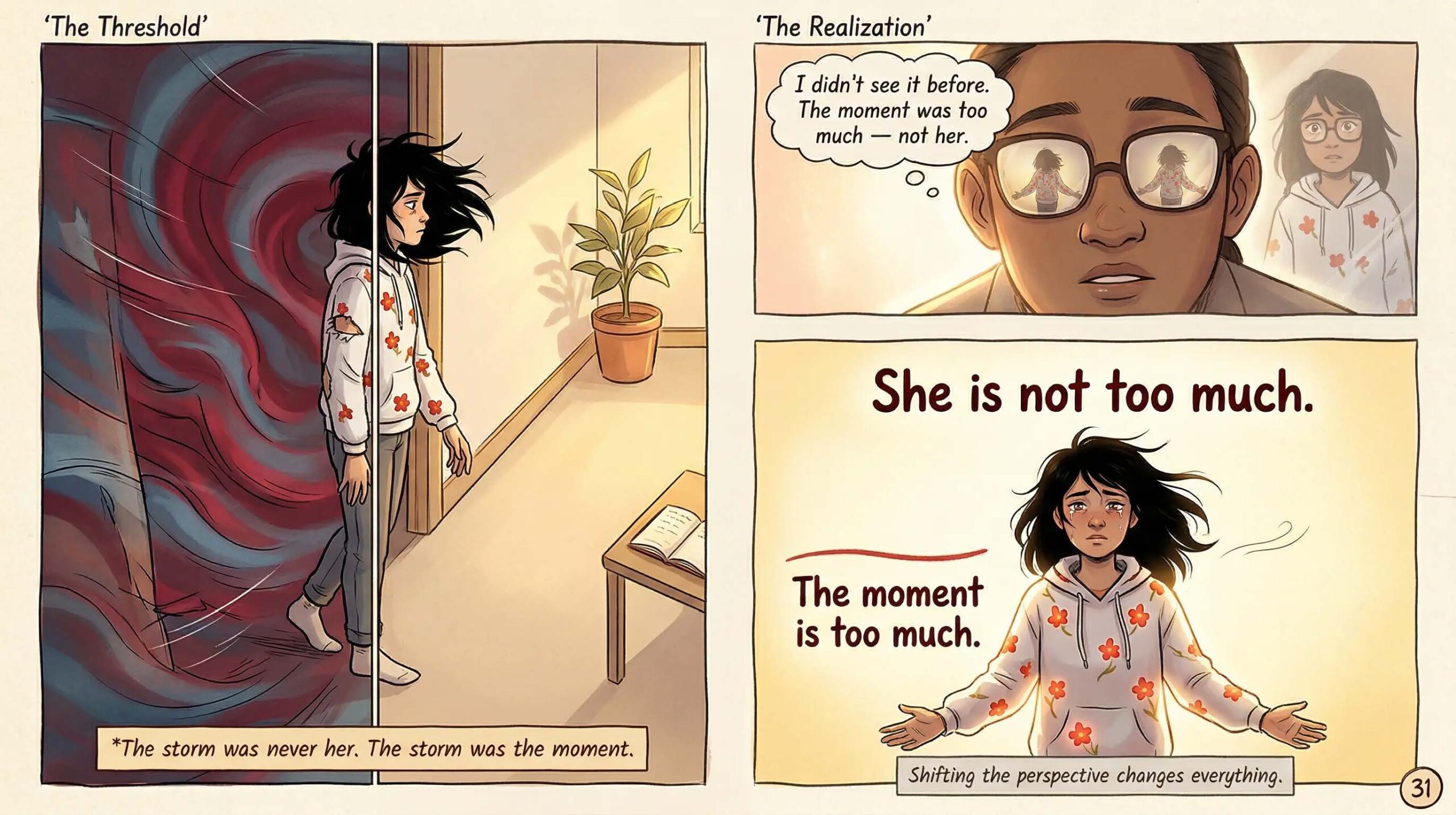
Comic page showing a girl standing at the threshold between an inner storm and a calm room, with a teacher realizing The moment was too much not her, and a full-panel text reading She is not too much The moment is too much — core neuroaffirmative message about emotional overload in neurodivergent girls
“She is not too much. The moment is too much.” This page carries the core message of the entire comic in a single visual.

A practical home activity: after reading pages 30 and 31 together, invite your daughter to draw or describe what her own “calm room” would look like. What sensory conditions does she need? What sounds, lighting, and textures help her return to herself? This becomes a direct input into her sensory diet plan and can inform accommodation requests at school.

Life
Using this comic in IEP and support planning

The comic is one of the most accessible tools available for building shared understanding between families, educators, and students in IEP meetings. It resolves a common problem in those meetings: the gap between what a parent describes and what a school team observes.

Pages 32 and 33: When understanding changes everything
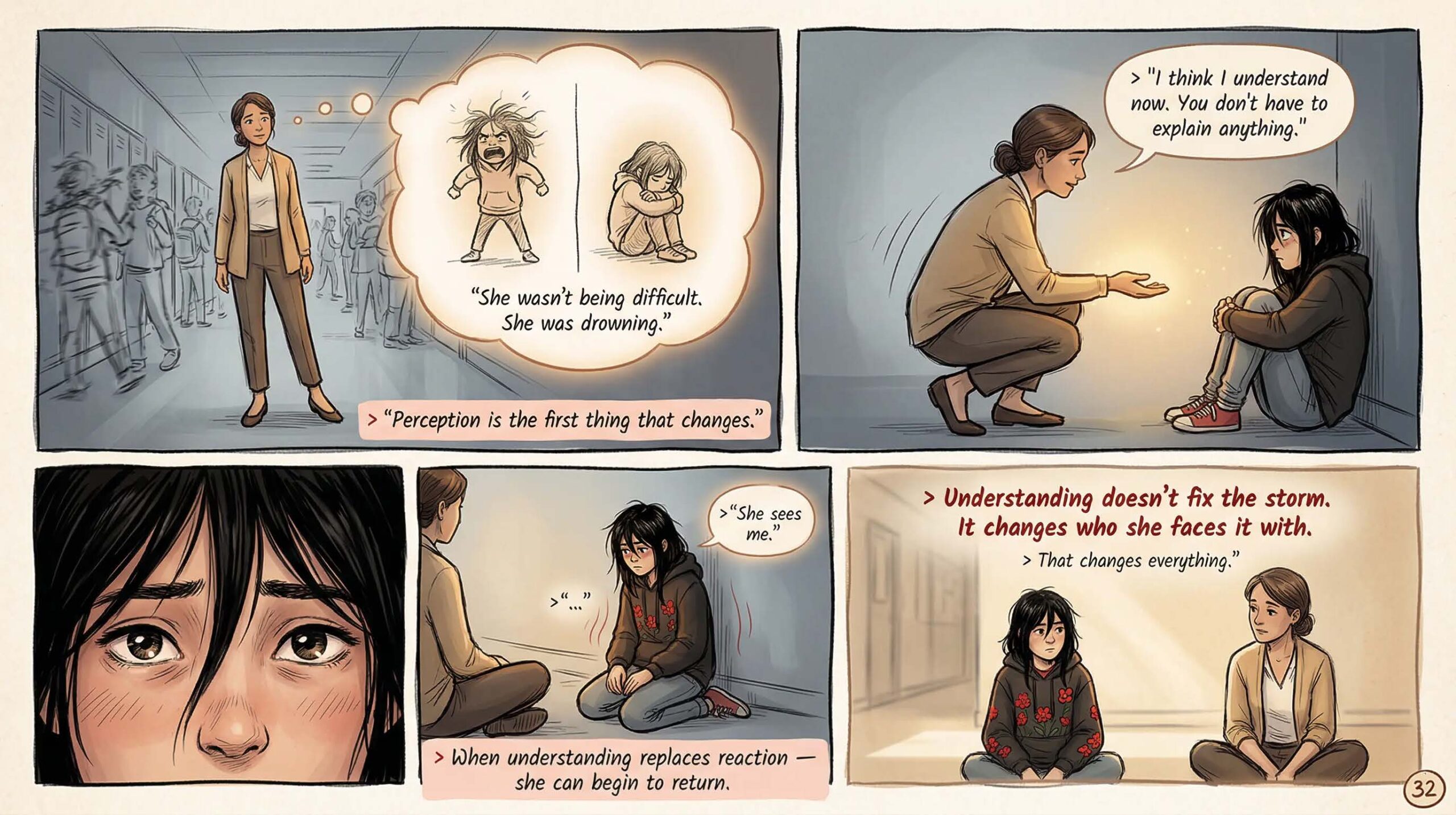
Comic page showing a teacher in the hallway recalling the girl's meltdown and thinking She wasn't being difficult she was drowning, then sitting beside the girl and saying I think I understand now you don't have to explain anything — captioned Understanding doesn't fix the storm It changes who she faces it with
“Understanding doesn’t fix the storm. It changes who she faces it with.” This is the shift that makes IEP teams effective.
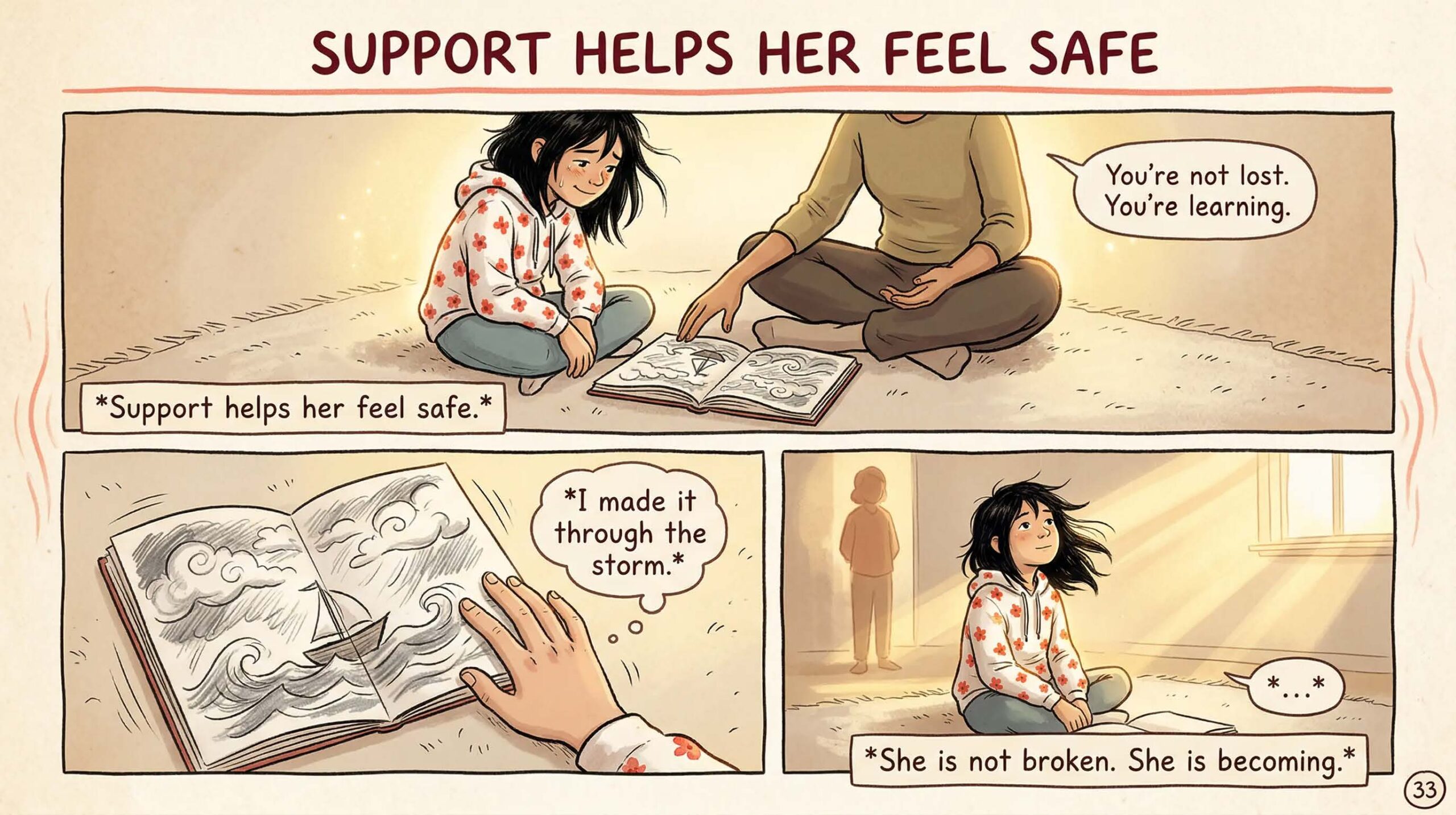
Comic page titled Support Helps Her Feel Safe — showing a girl smiling gently while sitting with a supportive adult reading a book together, captioned You're not lost you're learning and She is not broken She is becoming — depicts the healing impact of consistent adult support on neurodivergent girls with emotional overload
“She is not broken. She is becoming.” A reminder that the goal of all support is not compliance — it is safety, dignity, and growth.

In an IEP meeting context, pages 26 through 33 can be shared with the team in advance of the meeting itself. They establish a common language before the conversation begins. They reduce the energy a parent must spend convincing a team that their child’s experience is real. They also give the student, if she is present in her own IEP meeting, a visual vocabulary for describing her needs that does not require her to re-live them verbally.

Suggested IEP application: Print page 31 as a single-page reference and place it at the top of the accommodations section of the IEP document. The phrase “she is not too much, the moment is too much” reorients every accommodation conversation that follows from deficits to environment.
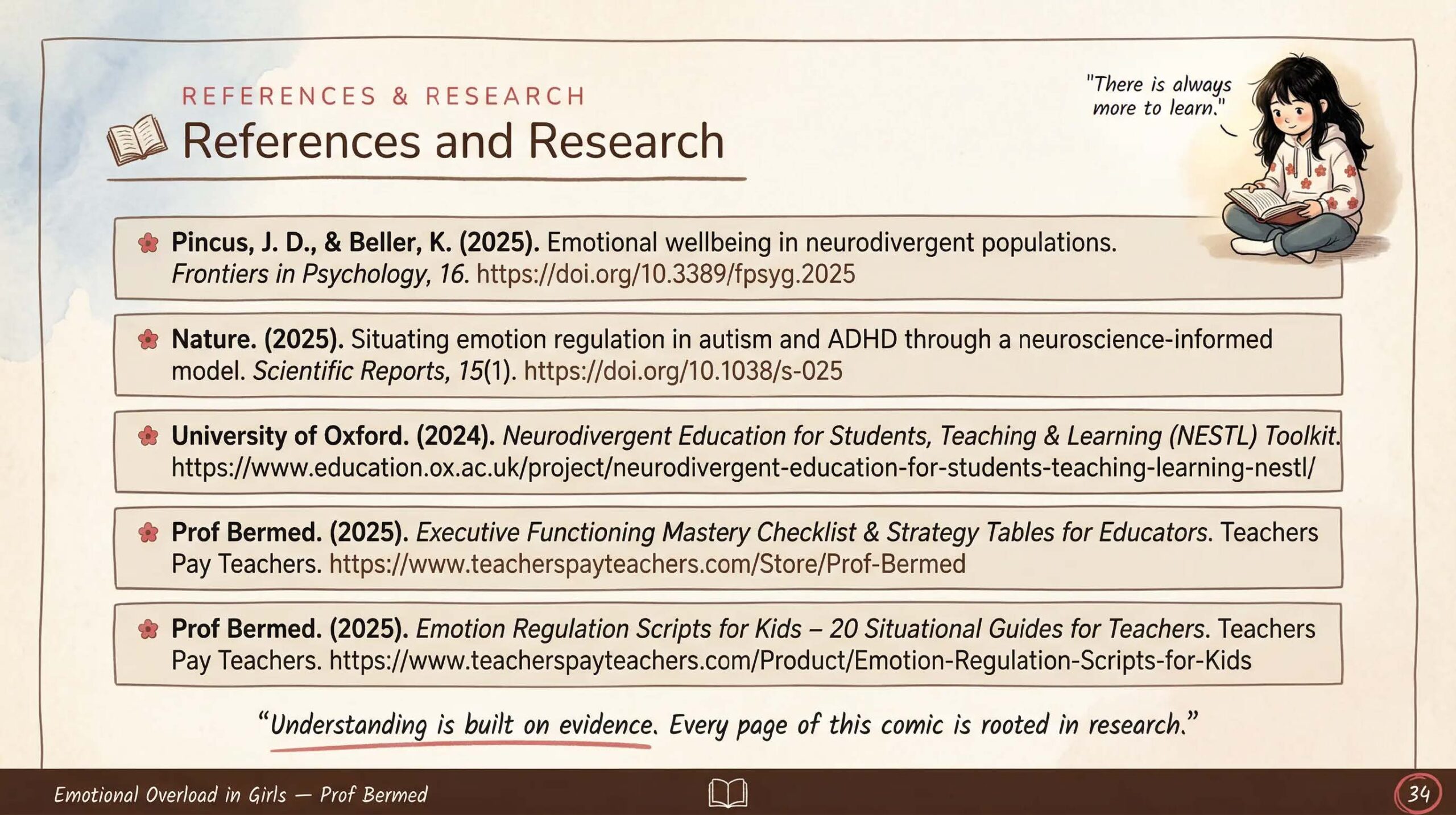
References and research page for the comic Emotional Overload in Girls by Prof Bermed, listing sources from Frontiers in Psychology 2025, Scientific Reports 2025, Oxford University NESTL Toolkit 2024, and Prof Bermed TPT resources — with the caption Understanding is built on evidence every page of this comic is rooted in research
Every page of this comic is grounded in peer-reviewed research, including sources from Frontiers in Psychology (2025), Scientific Reports (2025), and the Oxford University NESTL Toolkit (2024).
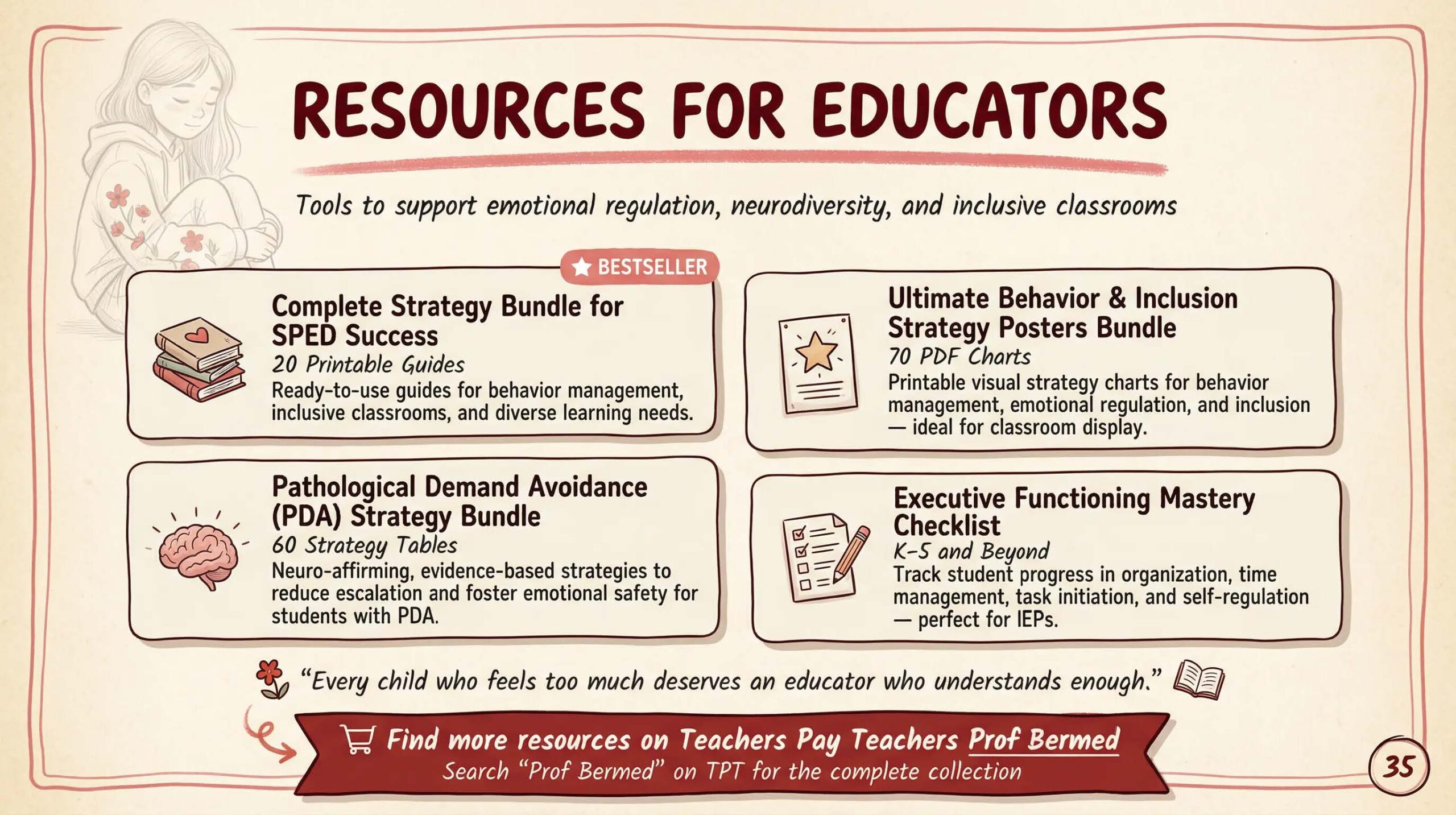
Resources for educators page from the comic Emotional Overload in Girls — featuring four Prof Bermed TPT products: Complete Strategy Bundle for SPED Success, Ultimate Behavior and Inclusion Strategy Posters Bundle, PDA Strategy Bundle, and Executive Functioning Mastery Checklist — tools to support emotional regulation and neurodiversity in inclusive classrooms
The comic’s final page points educators toward additional neuroaffirmative tools for the classroom, including strategy bundles and IEP-aligned resources.
Available on Teachers Pay Teachers

Get the Full 35-Page Comic

Download the complete print-ready PDF — research-backed, neuroaffirmative, and ready to use in your next staff meeting, parent session, or IEP conversation.

35 pages of sequential art Research-backed No ABA language Print & digital ready
Get the Resource on TPT

By Prof Bermed · IEPFOCUS.COM

Frequently asked questions

What age group is this comic best suited for?

The comic is designed for educators and parents rather than for children to read independently. For student use, individual pages work well with students aged 9 and up, particularly in a supported reading context with a trusted adult. The masking and peer judgment sections are most effective with students aged 11 and older.

Can this comic be used with boys as well as girls?

Yes. While the protagonist is a girl and the comic specifically addresses how emotional overload presents in girls, the neurological content is universal. The sensory, impulsivity, and co-regulation sections are directly applicable to any neurodivergent student regardless of gender. The framing around masking and invisibility may be particularly resonant for girls and gender-diverse students whose presentations are frequently missed by standard diagnostic criteria.

How does emotional overload differ from a standard meltdown?

Emotional overload is the accumulation process. A meltdown is one possible outcome of that process. The comic is valuable precisely because it documents the entire arc, not just the visible endpoint. Understanding the buildup is what makes early intervention possible.

Can this comic replace a Functional Behavior Assessment?

No. It is a complementary tool that supports the contextual understanding that an FBA requires. The comic helps educators and parents generate more accurate hypotheses about function and antecedents before and during the FBA process.

How do I introduce this comic to a student who resists talking about her emotions?

Start with the sensory pages (7, 12, 13) rather than the emotional ones. Sensory experience is concrete and less threatening to discuss than feelings. Once a student recognizes her own experience in those pages, she is often more willing to engage with the emotional content that follows.

Stephanie BERMED
Stephanie BERMEDhttps://iepfocus.com
Stephanie BERMED is a special education teacher and neurodiversity specialist, founder of IEPFOCUS.COM and the IEPPLANNERS community (515,000+ members). She creates evidence-based IEP resources, strategies, and guides for ADHD, autism, AuDHD, and PDA — used by educators and families across the United States. All content reflects a neuroaffirmative, strengths-based approach grounded in current research.

More from author

LEAVE A REPLY

Please enter your comment!
Please enter your name here

Recommended

IEP Individualized Education Programspot_img

Latest posts

The Complete Speech-Language Therapy Classroom Guide [2026]

/* ── Base ── */ .iep-article { font-family: Georgia, serif; font-size: 19px; line-height: 1.8; color: #2c2c2c; max-width: 860px; } .iep-article h2 { font-size: 1.65rem; color: #1A8A94;...

Is My Child Neurodivergent? The Complete Screening Quiz (2026)

Free 12-question neurodivergence quiz for parents and teachers. Screen for ADHD, autism, and AuDHD traits across school, home, sensory, and social domains. Instant results with next steps. Not a diagnosis.

Free OT Chart: Occupational Therapy Issues & Evidence-Based Recommendations [2026]

Download our free occupational therapy recommendations chart — 13 areas of concern, clinical descriptions, classroom examples, and evidence-based strategies for IEP teams.

Want to stay up to date with the latest news?

We would love to hear from you! Please fill in your details and we will stay in touch. It's that simple!