Most parents of children with a PDA profile arrive at this guide after something unexpected happened: the strategies that were supposed to help made things worse. The sticker charts, the visual schedules, the predictable routines, all of them added pressure instead of relieving it. That is not a parenting failure. It is a profile mismatch. Pathological Demand Avoidance and Extreme Demand Avoidance describe a specific pattern that requires a fundamentally different approach from standard autism support, and the research, while still developing, is clear enough to act on.
Approximately 1 in 5 autistic children show some indicators of PDA traits, and around 1 in 25 show a profile strongly consistent with the original clinical description, based on the only population cohort study to date, conducted in the Faroe Islands and reviewed in a peer-reviewed clinical overview. [1] That number is almost certainly underestimated in schools because so many of these children are still being managed under generic autism frameworks that do not fit their profile.
A 2021 systematic review found only 13 eligible studies meeting inclusion criteria, most relying on parent report, which is why this guide situates PDA/EDA within the broader, stronger evidence bases for autism, challenging behavior, and anxiety research, and flags where evidence is emerging versus established. [2] The goal is a practical, honest, and actionable resource for parents who need to act now, not wait for the definitive RCT.

The PDA strategies for parents below are grouped by daily situation, so you can start with the moment that is hardest at home.
What Is PDA/EDA? Definition and Diagnostic Status
Pathological Demand Avoidance (PDA) and Extreme Demand Avoidance (EDA) are terms used, especially in the United Kingdom, [4] to describe a pattern of pervasive, high-distress avoidance of everyday demands, including “wanted” activities once they become demands, often linked to high anxiety, a strong need for autonomy and control, and rapid escalation when pressure increases. PDA/EDA is not a standalone diagnosis in major diagnostic manuals, and its use varies by country and even by local services. Families may encounter the phrase “autistic with a PDA profile” rather than a formal diagnosis. [5]
In the research literature, PDA/EDA refers to a presentation characterized by extreme avoidance of everyday demands and attempts to maintain control, historically described by Elizabeth Newson and colleagues as a distinct pattern within pervasive developmental disorders. [6] Contemporary discussions frequently treat PDA/EDA as a profile or dimension most often described within autism, with ongoing debate about whether it constitutes a distinct syndrome. [6]
Major autism diagnostic systems provide no formal PDA diagnosis. The National Autistic Society states that PDA is not clinically recognized as a standalone diagnosis, that terminology use varies locally, and that there is no standardized assessment accepted everywhere. A 2024 scoping review similarly notes that PDA is not present in DSM-5 or ICD-11 and that there is no consensus on diagnostic validity. [5] [7]
Prevalence Estimates and Key Controversies
High-quality prevalence estimates are scarce because definitions and measures vary, sampling is often non-representative, and research is geographically concentrated. The best systematic review identified 13 studies and emphasized that heterogeneity and methodological limitations restrict conclusions about the uniformity and stability of the PDA constellation. [2]
The only population-cohort study to date suggested that about 1 in 5 autistic children showed some indications of PDA traits, while about 1 in 25 showed a profile “very consistent” with the original description. These figures should be treated as approximate and context-bound rather than universal, the cohort was conducted in the Faroe Islands, and cross-country generalization is uncertain. [1] [6]
Across reviews and professional commentary, the recurring concerns are: construct validity (is PDA distinct or a symptom cluster across conditions?); measurement (heavy reliance on parent-report tools); circularity (studying “PDA” largely within groups already labeled PDA); insufficient testing of alternative explanations such as anxiety, trauma, and ADHD; and ethical issues around pathologizing autonomy or mislabeling distress as manipulation. [2] The National Autistic Society reinforces the need for careful formulation rather than rigid “PDA rules,” noting that existing research is generally low quality. [5]
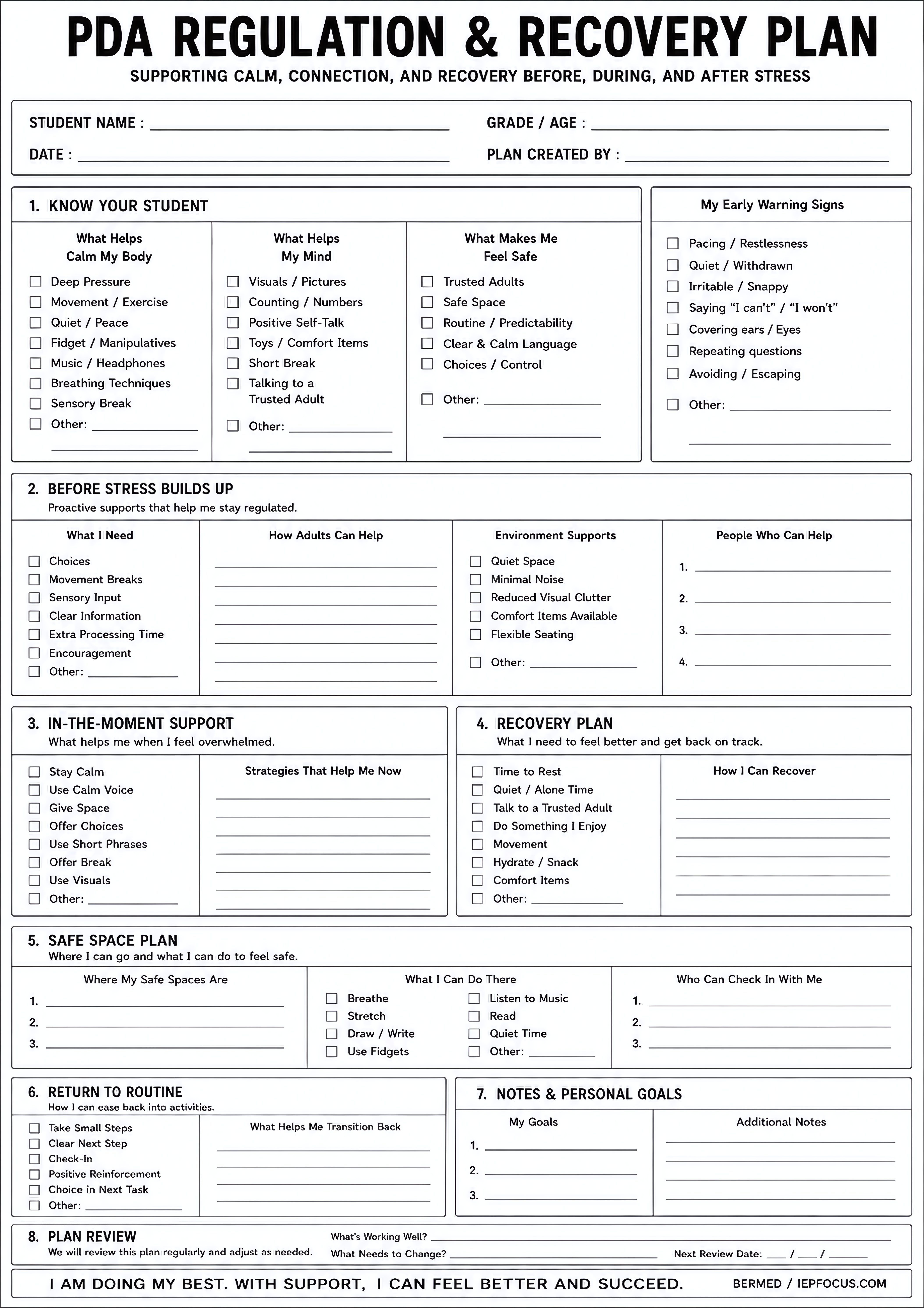
Free resource
PDA Regulation & Recovery Plan
A calm plan for connection, regulation and recovery after hard moments.
Download free →Neurodevelopmental Profile and Differential Diagnosis
PDA/EDA is typically described as demand avoidance that is unusually pervasive, emotionally reactive, and control-seeking, sometimes with sophisticated social strategies to deflect demands. These descriptions trace to Newson’s original criteria and later measurement studies including the EDA-Q and DISCO-based features, but the evidence base remains developing. [6]
What Distinguishes a PDA Profile from Other Autism Presentations?
One open-access comparison study reported that the PDA group had comparable autistic traits to an autism comparison group, but also elevated antisocial traits approaching a conduct-problem comparison group, and, crucially, emotional symptoms exceeding both groups. The same report notes that routine and repetition strategies often recommended for autism may be described as unhelpful for this subgroup, because rigidity can take the form of “routine becomes a demand.” [9]
PDA vs ODD and Conduct Problems
Reward-based techniques effective in conduct problems may not work well in a PDA profile, alongside the finding of higher emotional symptoms, consistent with a model where avoidance is strongly tied to distress and anxiety rather than to low fear or instrumental rule-breaking. This does not mean rewards never help; rather, they may be destabilizing if experienced as pressure or control. [9]
PDA vs ADHD
ADHD can mimic “demand avoidance” through executive dysfunction, impulsivity, and emotional dysregulation. Conversely, ADHD frequently co-occurs with autism and amplifies daily friction. Reviews emphasize that studies rarely control well for co-occurring neurodevelopmental conditions, and that assessment should actively screen for ADHD rather than assuming it is all PDA. [2]
PDA vs Trauma and Disrupted Early History
Challenging and dysregulated behavior is common after trauma or disrupted attachment histories and may complicate interpretation. The PDA research base has been criticized for insufficient consideration of alternative explanations such as trauma. If a child has known adversity, safeguarding concerns, bullying, or sudden onset or regression, trauma-informed assessment is essential. [1]
Evidence-Based PDA Strategies That Actually Work
Because PDA-specific trials are scarce, the table below distinguishes three evidence levels. Strong evidence means supported by autism, challenging behavior, or anxiety guidelines and/or RCT meta-analyses in autistic youth and families. Moderate evidence means supported by systematic reviews of single-case designs or consistent intervention literatures, but not PDA-specific. Emerging evidence means promising feasibility or pilot work, qualitative evidence, or well-reasoned clinical consensus for PDA/EDA, with limited controlled trials. [2]
| Strategy | Description | Age Groups | Evidence Level (2026) | Key Citations |
|---|---|---|---|---|
| Functional assessment + PBS-style plan | Identify triggers and functions (anxiety, sensory overload, communication breakdown, task difficulty), then redesign the environment and teach replacement skills | All ages | Strong (guideline-level for autism/challenging behavior; not PDA-specific) | NICE CG170 |
| Parent training / parent-mediated programs | Coaching parents in proactive supports, communication, and behavior management; often improves parent stress and child outcomes | Mostly child-adolescent | Strong-Moderate (systematic review + meta-analyses; heterogeneity) | Deb et al. 2020 |
| Adapted CBT for anxiety in autistic youth | CBT adapted with visuals, concrete language, parent involvement; targets anxiety that often drives avoidance | School-age to teens (sometimes adults) | Strong (systematic review + meta-analysis of RCTs) | Sharma et al. 2021 |
| Intolerance-of-uncertainty (IU) interventions (CUES) | Parent-based CBT-informed strategies to increase tolerance of uncertainty and reduce IU-linked anxiety | Children/teens (often 6-16) | Emerging (feasibility trials; growing evidence, not definitive) | Rodgers et al. 2022 · Autistica |
| Demand reduction + demand shaping | Temporarily reduce nonessential demands to restore regulation; reintroduce demands gradually with choice and collaboration | All ages | Emerging (PDA-specific clinical guidance; consistent with functional models) | O’Nions & Eaton 2020 · NAS |
| Low-demand communication (declarative language, indirect prompts, autonomy-supportive choices) | Reduce “felt coercion”; present options, invitations, and shared problem-solving rather than ultimatums | All ages | Emerging (PDA-specific consensus; indirectly supported by anxiety/regulation theory) | O’Nions & Eaton 2020 · Kildahl review 2021 |
| Functional Communication Training (FCT) | Teach a fast, acceptable way to request pause/help/choice, replacing escalation with communication | All ages, including minimally verbal | Moderate-Strong (meta-analyses in disability; strong effects in single-case literature) | Heath et al. 2015 · Walker et al. 2018 |
| Sensory/environmental supports (OT-guided) | Identify sensory triggers; adapt environment, sensory tools, and safe space; focus on functional participation | All ages | Moderate (guidance supports high-quality sensory practice; evidence varies by approach) | RCOT 2026 · NAS sensory |
| Low-arousal crisis de-escalation plan | Reduce arousal and confrontation during escalation; plan roles, exits, and recovery in advance | All ages | Moderate (theory + qualitative + guideline alignment; more outcome studies needed) | McDonnell et al. 2015 · NICE NG10 · McDonnell et al. 2024 |
| Transition planning (0-6 months) | Predictable, autonomy-supportive preparation for school changes, routines, vacations, puberty, service transitions | All ages (especially school transitions) | Moderate (guideline-consistent; limited PDA-specific trials) | NICE CG170 · CG128 |
A Parent-Friendly Core Protocol: Step by Step
Step 1: Stabilize First (Days to Weeks)
If you are in a cycle of daily escalation, prioritize safety and regulation over compliance. NICE recommends reassessing triggers and coexisting problems and using psychosocial approaches first. PDA clinical guidance similarly suggests reducing conflict points and rebuilding mutually rewarding routines. [3]
Step 2: Map Demands and Decide What Truly Matters (Demand Triage)
Create three categories, then intentionally reduce and reshape the optional layer for a short stabilization window of about two weeks before reintroducing gradually. This aligns with functional-assessment logic and with PDA-specific clinical summaries emphasizing gradual tolerance-building without strengthening habitual avoidance. [1]
| Category | Examples | Approach |
|---|---|---|
| Non-negotiable (safety/health) | Crossing roads safely, essential medication, basic sleep | Keep. Embed “control inside the boundary”, child chooses music, who clicks the buckle, which cup, the sequence. |
| Important but shapeable | School attendance steps, hygiene, homework dose | Break into micro-steps. Accept partial success. Build gradually from the smallest sustainable version. |
| Optional / social-norm | Perfect table manners, “because I said so” tasks | Pause entirely during stabilization. Revisit in 4 to 6 weeks. |
Step 3: Replace Confrontation with Autonomy-Supportive Communication
The goal is to remove “status battles” (who wins) and replace them with “shared goals” (how we get through the day). Research reviews argue that individualized management should be informed by social, sensory, and cognitive sensitivities and comorbid anxiety. The NAS notes that demand avoidance impacts essentials like eating, sleeping, and school attendance, so communication must be practical, not moralizing. [8]
Step 4: Treat Anxiety and Uncertainty as Primary Targets
CBT adapted for autistic youth has meta-analytic support for reducing anxiety. IU-focused interventions like CUES are promising, particularly because intolerance of uncertainty is repeatedly highlighted as a barrier that can amplify avoidance. [10]
Step 5: Build Communication and Coping Skills That Work in Real Time
FCT meta-analyses show strong effects for reducing challenging behavior by teaching a functionally equivalent communication response: “pause,” “help,” or “choose A/B.” The goal is not to eliminate autonomy, but to give the child a fast, safe way to signal overload without crisis. [11]
Low-Demand Language: A Practical Morning Conversion
Replace an imperative (“Get dressed now”) with a neutral observation (“We leave at 8:10”). Offer two real choices (“Blue shirt or black shirt?”) and a timing choice (“In 2 minutes or 5?”). Give control over sequence (“Shirt first or socks first?”). If resistance rises, pause the demand, reduce talk, and offer a reset (“Do you want a 2-minute break, then we try again?”). Reinforce any small step specifically (“You chose the shirt, nice. Next: socks or shoes?”). PDA/EDA overviews emphasize that hierarchical, adult-led insistence can rapidly worsen cooperation and behavior, and that strategies should create mutually rewarding routines and gradually increase demand tolerance. [1]
Demand Shaping a “Non-Negotiable” (Car Seat / Safety)
- State the boundary without escalation: “Car seat is required for safety.”
- Offer control inside the boundary, choose music, choose who clicks the buckle, choose a sensory object.
- Pre-empt overload: reduce sensory load (temperature, scratchy clothing, noise) before the transition.
- Use a “minimum viable step” sequence: sit in seat, buckle one clip, pause, finish buckle.
- Track and gradually reduce supports as tolerance increases over days and weeks.
This is consistent with functional assessment and environmental adaptation emphasized by NICE, plus PDA guidance emphasizing gradual tolerance and avoidance of escalating conflict. [3]
Teaching a “Pause Card” (FCT Principle)
- Pick one crisis-relevant message: PAUSE (word, gesture, or picture card).
- Practice when calm, for 30 to 60 seconds per day: “Show me PAUSE, great. Pause happens now.”
- During early escalation, prompt lightly (“Pause?”) and immediately honor a short pause without commentary.
- After the pause, offer a binary choice for the next step (A or B). The demand waits; the child accesses the pause safely.
Meta-analytic evidence supports FCT for reducing challenging behavior by strengthening functional communication responses. School-based AAC-FCT literature is also supportive. [11]
Case Vignettes: Real Scenarios, Practical Responses
The Homework Explosion
A 10-year-old autistic child panics and becomes aggressive when homework is presented. The family maps the pattern: the child escalates most when tasks are time-limited and when adults hover. They shift to demand shaping, homework becomes a “menu” of three micro-tasks to choose from, done alongside a preferred activity, with a pause card and a fixed 5-minute “do nothing” buffer after school. Crises drop significantly, and over 8 weeks the child tolerates longer tasks. This reflects PDA guidance emphasizing demand reduction plus gradual tolerance building, consistent with functional-assessment approaches to challenging behavior. [1]
School Refusal with Shame and Panic
A 14-year-old refuses school and melts down when pressured. The team discovers bullying and sensory overload in corridors, with anxiety spiking around unpredictable schedule changes. A phased plan begins with attendance for one protected period per day, a predictable entry route, a safe space, and staff using low-demand language. Parallel adapted CBT targets anxiety, while the family practices IU-tolerance steps (graduated uncertainty exposure). This matches evidence supporting adapted CBT for anxiety in autistic youth and the emerging rationale for IU-focused interventions, alongside environmental and safeguarding assessment. [10]
Crisis Cycles at Home
A 7-year-old escalates to prolonged screaming and throwing during transitions (bath, dinner, bedtime). Parents implement a low-arousal crisis plan: reduce language, increase physical space, remove spectators, and postpone nonessential demands during escalation. They also redesign the evening routine to be shorter, more predictable, and choice-based. Over time, crises shorten and parents report less stress, consistent with low-arousal models emphasizing reduction of physiological arousal and antecedent triggers, and with guidance favoring de-escalation and psychosocial methods. [12]
Sensory and Environmental Supports: Scope and Evidence Cautions
Sensory adaptations are often essential because demand avoidance can be compounded by sensory discomfort or overload, noise, transitions, crowding. The Royal College of Occupational Therapists updated its evidence-based Informed View in March 2026 to support occupational therapists in making decisions about sensory approaches and what high-quality sensory practice looks like. [13] The NAS notes that while sensory integration therapy may help some children, the research base remains limited and more research is needed. [14]
Practically, sensory support for a PDA profile should focus on reducing the sensory load that compounds the demand-threat response, not on adding structured sensory “programs” that themselves become demands. A safe, predictable sensory space the child can access on their own terms is often more effective than a scheduled sensory diet imposed by adults.
Crisis De-escalation: A Parent-Ready Mini-Protocol
A low-arousal approach focuses on reducing confrontation and physiological arousal during escalation. A review by Andrew McDonnell and colleagues proposes low-arousal strategies, reducing demands in crisis, avoiding arousing triggers like crowding or confrontational stance, while also noting that more research is needed. NICE’s violence and aggression guideline recommends staff training in anticipation, prevention, and de-escalation, and collaboration with those holding parental responsibility. Qualitative research with parents trained in low arousal reports themes of empowerment and advocacy. [12] [4] [15]
The critical design rule for a low-arousal crisis plan: it must be agreed and rehearsed before crisis occurs. Every adult who supports the child follows the same script. Improvised responses during crisis rarely reduce arousal. Planned ones can.
- Pause the demand: “We’ll pause.” Say it once. Do not repeat it.
- Lower stimulation: fewer words, softer tone, dim lights if possible. Every additional word adds arousal input.
- Increase space: step back, reduce direct eye contact if it escalates, reduce the number of people present.
- Offer an exit option: safe space, outside access, a specific named room. Make sure this is agreed in advance.
- Repair later: a brief, warm, non-blaming return to connection after the child has regulated. Not a consequence conversation.
This aligns with guideline principles emphasizing de-escalation and minimizing restrictive practices whenever possible. [4]
One-Page Parent Action Plan Template
This template is designed to be reviewed weekly for the first four weeks, then monthly. [3]
PDA/EDA Support Plan
Intervention Roadmap: 0 to 6 Months
This sequencing fits NICE’s emphasis on reassessing triggers, applying psychosocial interventions first, and using coordinated plans across environments. It also fits PDA clinical overviews emphasizing gradual tolerance building without reinforcing crisis cycles. [3]
Weeks 0-2: Stabilize
- Demand triage, reduce nonessential demands
- Crisis plan and low-arousal responses agreed and practiced
- School and home consistent language and safe space established
Weeks 3-6: Understand and Skill-Build
- Functional assessment: map triggers, sensory, anxiety, and communication patterns
- Teach PAUSE/help/choice communication (FCT)
- Start gentle demand shaping with short success routines
Months 2-4: Treat the Drivers
- Adapted CBT for anxiety (if available and accessible)
- IU-focused parent strategies (CUES-style)
- OT and SLT supports established; school plan refined
Months 4-6: Consolidate and Generalize
- Gradual demand increases with genuine child collaboration
- Transition planning for new term, vacations, routine changes
- Review outcomes and update plan against measured metrics
When and How to Seek Professional Assessment
Seek professional assessment, or reassessment, when there is marked impairment (school attendance collapse, severe family disruption), any safety risk, suspected co-occurring conditions (anxiety disorders, ADHD, depression), or concern about medical contributors such as sleep disorders, pain, or seizures. NICE guidance emphasizes reassessing potential triggers and coexisting conditions when behavior becomes challenging, and using structured diagnostic pathways when autism is suspected. [3]
Where PDA/EDA is not recognized locally, support can still be sought by describing the functional pattern: “demands trigger panic and rapid escalation; choice and low-pressure approaches reduce risk”, and requesting supports under recognized needs: autism supports, anxiety treatment, disability accommodations, and behavior support informed by assessment. [5]
Decision-Making Flowchart: When to Escalate
This reflects NICE recommendations for autism recognition, referral, and managing challenging behavior by reassessing triggers and coordinating care, paired with ethical guidance to match support to functional need rather than relying on contested labels. [16]
Recommended Professional Referrals
| Professional | Role | Indications | Expected Outputs |
|---|---|---|---|
| Developmental pediatrician / pediatric neurologist | Medical causes, neurodevelopmental coordination | Sleep/pain/seizures, developmental complexity | Medical evaluation, referrals, care coordination [16] |
| Child psychologist | Functional formulation, parent coaching, adapted CBT | Anxiety, avoidance, crises, school refusal | Written formulation, parent plan, CBT/IU protocols [10] |
| Child and adolescent psychiatrist | Complex comorbidity, medication evaluation if severe | Severe anxiety/depression, high risk, extreme aggression | Diagnostic clarification, risk plan, medication only when indicated [17] |
| Speech-language therapist (SLT) | Communication supports, pragmatic language, AAC | Communication breakdown precedes rapid escalation | Communication plan, scripts, AAC supports [16] |
| Occupational therapist (OT) | Sensory profile, environment redesign, daily living support | Sensory overload, transitions, motor/self-care difficulties | Sensory/environment plan, participation goals, school accommodations [13] |
| Educational psychologist / school psychologist | School plan, accommodations, staff training | School distress/refusal, exclusions, unknown learning profile | Individual plan, staff strategies, monitoring framework [16] |
| Social worker / family support services | Benefits, respite, safeguarding coordination | Caregiver burnout, resource needs, safety concerns | Access to respite/supports, safeguarding response [4] |
Country Differences to Expect
PDA/EDA language is most commonly used in the UK, and acceptance varies by local commissioners and clinicians. Outside the UK, many services will not use “PDA,” but supports can still be obtained through autism, anxiety, disability accommodations, and functional behavioral assessment frameworks. The scoping review literature confirms the UK-dominant research base, and the NAS explicitly notes non-standardized terminology use. [7]
Ethical Considerations, Cultural Factors, and Evidence Gaps
Ethical Considerations
A central ethical risk is treating PDA/EDA as a “character flaw”, interpreting a child as “manipulative” or “won’t” rather than understanding it as a distress pattern. The leading critique argues that PDA is better understood through interactions among social, sensory, and cognitive sensitivities and comorbidities, requiring shared understanding between professionals and families, limiting blame and coercion. [8]
The World Health Organization emphasizes a rights-based approach to autism assessment and care, including access to appropriate support, inclusion, and safeguarding, reinforcing that support planning should prioritize dignity and well-being rather than compliance at any cost. [18]
Cultural and Contextual Factors
Demand avoidance is shaped by context: school structures, disciplinary norms, family expectations, and access to accommodations can all alter what “counts” as a demand and how much autonomy a child can safely exercise. A notable gap identified in the 2024 scoping review is the lack of sociocultural reflection in PDA research, suggesting that cross-cultural work is essential before global generalizations are made. [7]
Evidence Gaps and Research Priorities
The most consistent findings from systematic and scoping reviews are that PDA research needs: clearer operational definitions and measurement beyond parent report; representative sampling and cross-country replication; longitudinal studies to determine stability across development; rigorous testing of alternative explanations and comorbidity pathways (anxiety, ADHD, trauma); and controlled trials evaluating PDA-informed adaptations, low-demand communication, demand shaping, low-arousal plans, with quality-of-life outcomes. [2]
In the meantime, the most evidence-defensible clinical stance is to use PDA/EDA descriptively if it improves shared understanding, but to anchor intervention in evidence-supported autism and anxiety care, and to continuously verify the plan against outcomes, crisis frequency, sleep, attendance, and well-being. [3]
More PDA Strategies for Parents
- The PDA Hub: every guide on pathological demand avoidance in one place
- What is pathological demand avoidance?
- The PDA profile in autism
- PDA vs ODD: how to tell the difference
- PDA and anxiety
Frequently Asked Questions
References
Deb, S. S., Retzer, A., Roy, M., Acharya, R., Limbu, B., & Roy, A. (2020). The effectiveness of parent training for children with autism spectrum disorder: a systematic review and meta-analyses. BMC Psychiatry. PMC7720449
Gillberg, C., et al. (2015). Extreme (“pathological”) demand avoidance in autism: a general population study in the Faroe Islands. Discussed via peer-reviewed overview. O’Nions & Eaton 2020
Green, J., Absoud, M., Grahame, V., Malik, O., Simonoff, E., Le Couteur, A., & Baird, G. (2018). Pathological demand avoidance: symptoms but not a syndrome. The Lancet Child & Adolescent Health. Manchester repository
Haire, L. H., Symonds, J., Senior, J., & D’Urso, G. (2024). Methods of studying pathological demand avoidance in children and adolescents: a scoping review. Frontiers in Education. DOI: 10.3389/feduc.2024.1230011
Heath, A. K., et al. (2015). A meta-analytic review of Functional Communication Training across mode of communication, age, and disability. Behavior Analysis in Practice. SpringerLink
Kildahl, A. N., et al. (2021). Pathological demand avoidance in children and adolescents: a systematic review. Autism. Sage Journals
McDonnell, A., et al. (2015). The role of physiological arousal in the management of challenging behaviours in individuals with autistic spectrum disorders. Research in Developmental Disabilities. ScienceDirect
McDonnell, A. A., et al. (2024). Families’ experiences of the Low Arousal Approach: a qualitative study. Frontiers in Psychology. DOI: 10.3389/fpsyg.2024.1328825
National Autistic Society. Demand avoidance. autism.org.uk
Newson, E., Le Marechal, K., & David, C. (2003). Pathological demand avoidance syndrome: a necessary distinction within the pervasive developmental disorders. Archives of Disease in Childhood. PMC1763174
NICE (2011; updated). Autism spectrum disorder in under 19s: recognition, referral and diagnosis (CG128). nice.org.uk/cg128
NICE (2013; updated). Autism spectrum disorder in under 19s: support and management (CG170). nice.org.uk/cg170
NICE (2015; reviewed 2024). Violence and aggression: short-term management in mental health, health and community settings (NG10). nice.org.uk/ng10
O’Nions, E., Viding, E., Greven, C. U., Ronald, A., & Happe, F. (2014). Pathological demand avoidance: exploring the behavioural profile. Autism. UCL repository
O’Nions, E., Christie, P., Gould, J., Viding, E., & Happe, F. (2014). Development of the Extreme Demand Avoidance Questionnaire (EDA-Q). Journal of Child Psychology and Psychiatry. Tavistock repository
O’Nions, E., Gould, J., Christie, P., Gillberg, C., Viding, E., & Happe, F. (2016). Identifying features of “pathological demand avoidance” using the DISCO. European Child & Adolescent Psychiatry. PMC4820467
O’Nions, E., & Eaton, J. (2020). Extreme/”pathological” demand avoidance: an overview. Paediatrics and Child Health. ScienceDirect
Rodgers, J., et al. (2022). Coping with uncertainty in everyday situations (CUES) to address IU in autistic children: an intervention feasibility trial. PMC10465370
Royal College of Occupational Therapists (2026). Sensory approaches: Using sensory integration therapy, sensory-based interventions and sensory approaches with children and young people. RCOT
Sharma, S., et al. (2021). Cognitive behavioural therapy for anxiety in children and young people on the autism spectrum: a systematic review and meta-analysis. BMC Psychology. SpringerLink
Walker, et al. (2018). A systematic review of Functional Communication Training. PubMed 29783913
World Health Organization (2025). Autism fact sheet. who.int
British Psychological Society (2020). PDA, a new type of disorder? The Psychologist. bps.org.uk
Autistica. Research update: coping with uncertainty and IU in autistic children. autistica.org.uk