Understanding PDA and ADHD side by side helps parents and teachers choose supports that reduce conflict instead of adding to it.
If you have ever read an ADHD description and thought “yes, but it is deeper than that”, or if someone in your family has an ADHD diagnosis but the standard strategies consistently backfire, the PDA profile may be part of the picture. Pathological demand avoidance and ADHD are among the most commonly confused and most commonly co-occurring neurodevelopmental profiles. Understanding where they overlap, where they diverge, and what to do when both are present is one of the most practically important distinctions in current neuroaffirmative practice.
This guide covers the neuroscience, the behavioral differences, the diagnostic challenges, and the support approaches that work, and those that reliably make things worse.
What Is the Difference Between PDA and ADHD?
Both PDA and ADHD are neurodevelopmental profiles with roots in how the brain regulates attention, impulse, emotion, and threat. Both produce significant task avoidance, difficulties with transitions, emotional dysregulation, and challenges in structured environments. But the underlying mechanism, and therefore the correct support response, is fundamentally different.
PDA: Pathological Demand Avoidance
- Avoidance driven by anxiety and perceived threat to autonomy
- Demand threshold is the key variable, any externally imposed expectation can trigger avoidance
- Socially skilled, often uses humor and negotiation to deflect demands
- Identity feels fluid or role-based; persona-switching is common
- High masking ability in short bursts; severe post-social exhaustion
- Standard behavioral reward/consequence systems actively worsen symptoms
- Sits within the autism spectrum; profile described by Elizabeth Newson (1980s)
ADHD: Attention Deficit Hyperactivity Disorder
- Avoidance driven by executive dysfunction and dopamine dysregulation
- Difficulty initiating, sustaining, and switching tasks regardless of who imposes them
- Often impulsive in social settings; less likely to mask via social negotiation
- Identity typically more stable; self-esteem affected by performance gaps
- Hyperfocus possible on preferred tasks; avoidance is more indiscriminate
- Responds to structure, reward systems, and medication more predictably
- Separate DSM-5 diagnosis; three subtypes (inattentive, hyperactive-impulsive, combined)
The simplest clinical test: remove the external authority from the demand. Ask the person to do the same task but frame it as entirely their own choice, with no consequence for not doing it. In ADHD, the task difficulty largely persists, the problem is executive initiation regardless of framing. In PDA, the perceived autonomy shift often dramatically lowers the resistance threshold. This is not a perfect test, but it points directly at the mechanism difference.

The internal experience of PDA+ADHD is often one of exhaustion: the ADHD creates initiation difficulty while the PDA creates an anxiety-driven threat response to the demands accumulating around that difficulty.
Where PDA and ADHD Genuinely Overlap
The surface-level behavioral overlap between PDA and ADHD is real and significant. This is one of the primary reasons each profile is misidentified as the other, and why a PDA+ADHD co-occurrence can be particularly difficult to recognize and support.
Shared features across PDA and ADHD
- Task avoidance: Both profiles produce significant difficulty completing demanded tasks, particularly those that are tedious, unpredictable, or externally timed
- Emotional dysregulation: Both involve rapid, intense emotional responses that appear disproportionate to the apparent trigger
- Difficulty with transitions: Moving from a preferred activity to a non-preferred one is effortful and often resisted in both profiles
- Inconsistent performance: Both profiles produce significant variability, the person can appear highly capable in some contexts and completely unable in others
- Social difficulties: Both affect relationships, though through different mechanisms (impulse control in ADHD; demand load and masking in PDA)
- Rejection sensitivity: RSD (rejection sensitive dysphoria) is common in ADHD and overlaps with the PDA sensitivity to perceived criticism or loss of control
- Sleep difficulties: Both profiles are associated with dysregulated sleep, though the causes differ
According to research published in the Journal of Neuroscience.org, both PDA and ADHD involve dysregulation of dopaminergic and noradrenergic circuits, which is why stimulant medication can affect both profiles, though not always in the same direction or with the same predictability.
Why the overlap causes so many missed diagnoses
When a child or adult is assessed for ADHD and receives a positive diagnosis, clinicians frequently stop there. The ADHD framework explains enough of the presentation to feel complete. The PDA profile, which has no standalone DSM category and requires specific clinical knowledge, remains invisible. The result is an ADHD treatment plan (behavior contracts, reward charts, structured schedules, CBT) that consistently fails or worsens outcomes, producing a cycle of “treatment-resistant ADHD” that is actually unrecognized PDA.
The Children and Adults with Attention-Deficit/Hyperactivity Disorder organization (CHADD).org acknowledges that ADHD co-occurs with anxiety disorders in approximately 50% of cases, and it is within this anxiety-ADHD group that unrecognized PDA is most likely to be present.
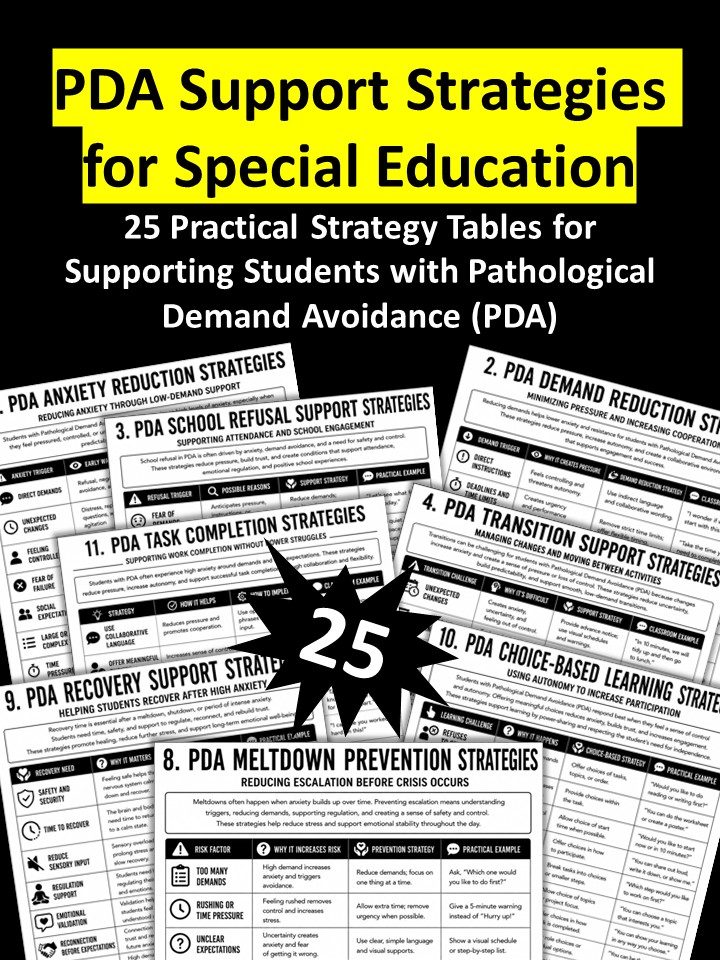
Free resource
PDA Support Strategies for Special Education
25 practical, neuroaffirming strategies for students with demand avoidance.
Download free →PDA and ADHD Together: The Co-occurring Profile
When PDA and ADHD genuinely co-occur, which happens in over half of confirmed PDA cases, the combined presentation is more complex and more demanding than either profile alone. Understanding this combination is essential for parents, educators, and clinicians working with this population.
How ADHD amplifies PDA demand avoidance
ADHD executive dysfunction means that even tasks the person genuinely wants to do require significant neurological effort to initiate. When this initiation difficulty collides with PDA’s anxiety-driven avoidance response, the result is a demand load that is both practically harder to manage and internally more distressing. The person experiences both the ADHD friction of starting and the PDA threat-response to the demand, simultaneously.
This is why PDA+ADHD individuals often appear to have dramatically inconsistent “willpower”: they can hyperfocus intensely on self-directed activities (ADHD’s interest-based nervous system) while being completely unable to meet even minimal external demands (PDA’s threat response). From the outside, this inconsistency can be misread as deliberate non-compliance or manipulation.
How PDA complicates ADHD treatment
Standard ADHD interventions, behavioral reward charts, structured daily schedules, consequence-based systems, CBT-based habit formation, all impose external demand structure. For a PDA+ADHD individual, this structure is itself a demand trigger. The treatment designed to help the ADHD becomes the source of PDA dysregulation. Medication may help with the ADHD component but will not address the PDA demand-avoidance mechanism, and in some cases can increase anxiety if the underlying PDA is unrecognized.

In PDA+ADHD, executive dysfunction makes starting difficult, while the PDA threat response makes demands feel dangerous. The combined experience is significantly more overwhelming than either profile in isolation.
Rejection sensitive dysphoria: the overlap point that matters most
Rejection sensitive dysphoria (RSD), intense emotional pain triggered by perceived rejection, criticism, or failure, is one of the most clinically significant overlap points between ADHD and PDA. In ADHD, RSD is well-documented and linked to dopaminergic dysregulation (Dodson, 2016). In PDA, the sensitivity to perceived criticism or loss of control produces a similar phenomenology through a different neurological pathway.
When both are present, the combined RSD experience can be severe. A correction from a teacher, a declined invitation, a perceived change in tone, all can trigger an extreme response that looks like a meltdown, a shutdown, or an aggressive outburst. Understanding whether the trigger is ADHD-related RSD, PDA demand response, or both is essential for responding in a way that de-escalates rather than compounds.
| Feature | ADHD alone | PDA alone | PDA + ADHD |
|---|---|---|---|
| Task avoidance | Executive initiation difficulty; inconsistent across task types | Anxiety-driven; keyed to perceived demand rather than task difficulty | Both mechanisms active simultaneously; unpredictable and severe |
| Response to structure | Often helpful; predictable routine reduces cognitive load | Counterproductive; structure adds demand load | Must be extremely flexible; demands disguised as choices |
| Medication response | Typically positive for stimulants; improves focus and initiation | Not specifically targeted; may increase anxiety if PDA unrecognized | May help ADHD component while leaving PDA avoidance unchanged |
| Social presentation | Impulsive; social difficulties from poor impulse control | Socially strategic; uses charm and negotiation to manage demands | Variable; can switch between ADHD impulsivity and PDA social maneuvering |
| Emotional dysregulation | RSD-linked; intense but typically short-lived | Demand-load linked; builds over time toward shutdown or meltdown | Both patterns; triggers compound each other |
| Behavioral support | Responds to consistent structure, clear expectations, reward systems | Requires low-demand, autonomy-based, collaborative approaches | Requires PDA-informed low-demand approach as the base |
Diagnosing PDA and ADHD: What Assessment Should Look Like
Because ADHD has a clear DSM-5 diagnostic pathway and PDA does not, most assessments will identify the ADHD component and miss the PDA profile. A thorough assessment for someone presenting with ADHD features should explicitly explore:
- Whether task avoidance is consistent across self-directed and externally-directed contexts (ADHD pattern) or specifically triggered by perceived external demand (PDA pattern)
- The role of anxiety in driving avoidance, not as a co-occurring disorder but as the mechanism of the avoidance itself
- The presence of social masking and persona-switching, which are characteristic of PDA but not core ADHD features
- History of “treatment-resistant” ADHD or consistent failure of behavior management approaches
- The individual’s experience of their own avoidance, shame and frustration (more typical of ADHD) versus threat and survival response (more typical of PDA)
The PDA Society’s guidance on PDA and ADHD.org is the most clinically detailed resource currently available on differential and co-occurring assessment for these two profiles. The National Institute of Mental Health’s ADHD overview.gov provides the standard diagnostic framework against which PDA features can be compared.
PDA in Adults: Signs, Diagnosis & Daily Life If you are an adult navigating a PDA profile alongside ADHD, our complete guide to pathological demand avoidance in adults covers the full picture, including why so many adults with PDA are misdiagnosed for years.What Works: Support Strategies for PDA+ADHD
When both profiles are present, the PDA-informed approach must be the foundation. Adding ADHD-specific structure on top of a PDA profile without first establishing the low-demand base will consistently fail. The sequence matters.
Start with the PDA layer: reduce the demand base
Before any ADHD executive function support can land, the person’s overall demand load must be brought within their window of tolerance. This means auditing all sources of demand, academic, domestic, social, sensory, and systematically reducing the non-essential ones. Only when the person is operating below their demand threshold does ADHD support become accessible to them.
The FLOW Framework for PDA+ADHD Support, by Stephanie Bermed
Medication considerations
Stimulant medication for the ADHD component can be genuinely helpful in PDA+ADHD presentations, but requires careful monitoring. For some individuals, stimulants reduce the cognitive friction that amplifies demand load, making PDA avoidance responses less frequent. For others, stimulants increase baseline anxiety, lowering the PDA demand threshold and worsening avoidance. This variability makes clinical monitoring of anxiety specifically, not just attention, essential when trialing medication in this population.
Non-stimulant options (atomoxetine, guanfacine) may be preferable for individuals where anxiety amplification is a concern. Current guidance from the American Academy of Pediatrics.org on ADHD medication decisions provides a useful framework, with the caveat that PDA-specific anxiety monitoring is not yet reflected in standard guidelines.
In school and classroom settings
For students with both PDA and ADHD, the IEP or 504 plan must explicitly address both profiles. Standard ADHD accommodations (preferential seating, extended time, chunked assignments) should be offered as available options rather than mandatory requirements. The language in the accommodation itself matters: “student may use extended time” is less demand-invoking than “student will complete tests in two sessions.”
For detailed IEP planning guidance for students with the PDA profile, see our full resource on PDA IEP planning: accommodations, goals, and regulation supports.

The same outward behavior, task refusal, can stem from fundamentally different mechanisms depending on whether PDA, ADHD, or both are driving it. Getting the mechanism right determines whether the support response helps or harms.
For Parents: Recognizing the Difference at Home
At home, the practical question is often not “which diagnosis is correct” but “why does nothing I try consistently work.” If your child has an ADHD diagnosis and you have faithfully implemented reward charts, consistent routines, and logical consequences, and it has not worked, the PDA profile may be part of what you are dealing with.
Some questions worth reflecting on:
- Does the avoidance shift significantly when you remove the sense that something is required, offering the same activity as a free choice?
- Does your child use unusually sophisticated social negotiation to avoid demands, humor, distraction, elaborate excuses, for their age?
- Are meltdowns or shutdowns specifically keyed to demand situations, even low-stakes ones?
- Does your child show a strong need to feel in control of their environment that goes beyond ordinary preference?
- Do standard ADHD strategies (reward charts, structured routines, consequences) consistently produce the opposite of the intended effect?
If the answer to several of these is yes, exploring the PDA profile with a clinician who has explicit PDA knowledge is a productive next step. Our comprehensive PDA overview for parents and educators covers the full profile in accessible detail. For the difference between PDA and another commonly confused profile, see our comparison of PDA vs ODD.
For Clinicians: The Assessment Checklist
When ADHD is confirmed or suspected and a PDA profile has not yet been considered, the following flags in presentation should prompt explicit PDA exploration:
- Avoidance is specifically demand-triggered rather than task-difficulty triggered
- High social masking ability inconsistent with autism presentation expectations
- History of failed behavioral interventions that work for ADHD
- Reports of “choosing” avoidance that, on closer questioning, describe an involuntary threat response
- Identity instability or persona-switching beyond ADHD self-esteem difficulties
- Anxiety that predates or exceeds what would be explained by ADHD alone
The National Autistic Society’s clinical PDA guidance.org and the PDA Society’s professional resources.org are the strongest current references for expanding clinical competency in this area. For a detailed profile explanation, see our article on the PDA profile in autism.
Frequently Asked Questions
References
Sources cited and recommended reading
- O’Nions, E., Gould, J., Christie, P., Gillberg, C., Viding, E., & Happé, F. (2023). Identifying features of ‘pathological demand avoidance’ using the Diagnostic Interview for Social and Communication Disorders (DISCO). European Child & Adolescent Psychiatry. link.springer.com
- Newson, E., Le Maréchal, K., & David, C. (2003). Pathological demand avoidance syndrome: A necessary distinction within the pervasive developmental disorders. Archives of Disease in Childhood, 88(7), 595–600. adc.bmj.com
- Barkley, R. A. (2015). Attention-Deficit Hyperactivity Disorder: A Handbook for Diagnosis and Treatment (4th ed.). Guilford Press.
- Dodson, W. W. (2016). Emotional regulation and rejection sensitive dysphoria. Psychiatry & Behavioral Health Learning Network. psychiatryadvisor.com
- Christie, P., Duncan, M., Fidler, R., & Healy, Z. (2012). Understanding Pathological Demand Avoidance Syndrome in Children. Jessica Kingsley Publishers.
- Gillberg, C., Gillberg, I. C., Thompson, L., Kadesjo, B., & Ehlers, S. (2015). Extreme (“pathological”) demand avoidance in autism: A general population study in the Faroe Islands. European Child & Adolescent Psychiatry, 24(8), 979–984.
- PDA Society (2024). PDA and ADHD: Clinical guidance for practitioners. pdasociety.org.uk
- National Institute of Mental Health (2024). Attention-Deficit/Hyperactivity Disorder. U.S. Department of Health and Human Services. nimh.nih.gov
- American Academy of Pediatrics (2023). Clinical practice guideline for ADHD diagnosis, evaluation, and treatment. aap.org
- National Autistic Society (2024). Pathological demand avoidance: Professional practice guidance. autism.org.uk