

AI therapy for autistic children is no longer a distant promise. Every autistic child is different — their sensory profile, communication style, regulatory needs, and learning pace are uniquely their own. Yet for decades, therapeutic models have largely followed a one-size-fits-all approach. Artificial intelligence is beginning to change that, and the evidence is growing.
What Does « Personalized Therapy » Really Mean?
Personalized therapy goes beyond choosing between speech therapy and occupational therapy. It means adjusting the pacing, content, modality, and emotional tone of an intervention based on continuous data about how a specific child is responding — not how children in a study group responded on average.
For autistic children, this matters enormously. A child who is dysregulated on a given morning will not benefit from the same session design as a child who is calm and focused. A child who communicates through AAC needs feedback loops that are entirely different from those built for a verbally fluent child.
A personalized therapy session integrating adaptive technology alongside human support — the combination the research consistently recommends.
Traditional therapy cannot adapt fast enough — not because therapists lack skill, but because human attention has limits and session time is finite. This is precisely where AI-assisted tools are beginning to demonstrate genuine value.
What the Research Actually Shows
The last three years have seen a notable acceleration in peer-reviewed research on AI therapy for autistic children. What follows is a summary of the most rigorous findings available as of early 2026.
AI Platforms as Therapeutic Supplements
A 12-month longitudinal observational study published in JMIR Neurotechnology (Atturu et al., 2025) followed 43 autistic children aged 2 to 18 using an AI-based platform called Cognitivebotics alongside their ongoing therapy. Outcomes were measured using standardized tools including the Childhood Autism Rating Scale (CARS), the Vineland Social Maturity Scale (VSMS), and the Receptive Expressive Emergent Language Test (REEL). The platform demonstrated meaningful improvements across cognitive, social, and developmental domains — functioning as an effective supplement to, not a replacement for, human-led therapy.
The researchers noted that future AI tools must prioritize multilingual accessibility and cultural sensitivity — a finding directly relevant to educators in North Africa, South Asia, and other under-represented regions where most existing tools were never designed or validated.
Machine Learning and Real-Time Adaptation
Researchers at the Indian Institute of Information Technology Allahabad have been exploring machine learning approaches to early autism detection and intervention design using Indian population data (Shrivastava et al., 2024). Their work demonstrates that ML models trained on culturally and linguistically relevant datasets meaningfully improve both diagnostic accuracy and intervention matching.
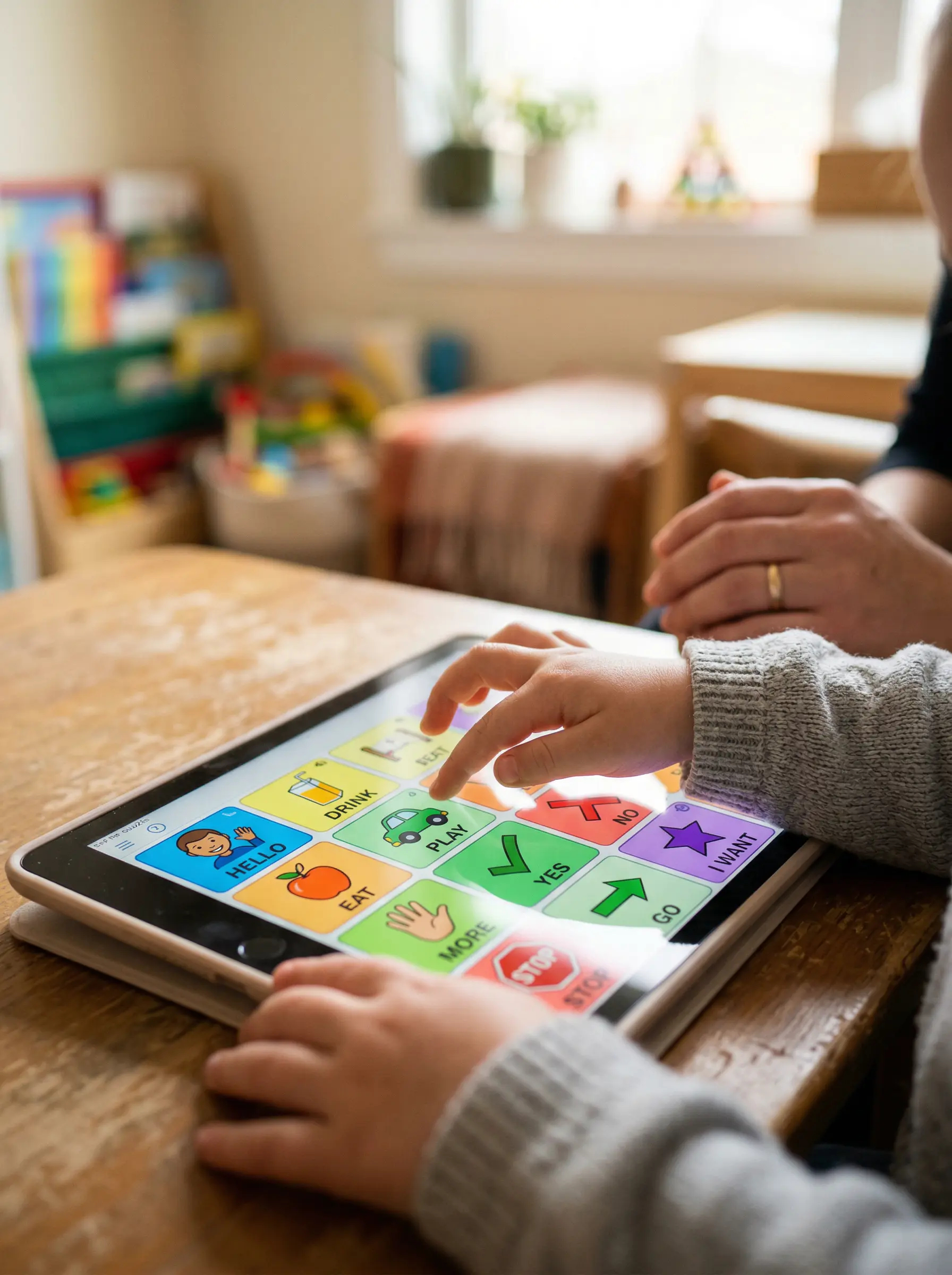
Real-time data from adaptive apps helps therapists make better-informed decisions between and during sessions.
A 2024 systematic review published in npj Digital Medicine (Wu et al., 2024) examined AI-assistive technologies for neurodevelopmental conditions in everyday environments. Across included studies, AI-driven tools showed improvements in social skills, communication (including imitation and turn-taking), and daily living skills. Studies involving socially assistive robots reported increases in eye contact and verbal initiation, with some gains persisting after the intervention ended.
Generative AI: A New Frontier
A 2025 scoping review in Frontiers in Psychiatry (Frontiers, 2025) examined how generative AI — including large language models like GPT-4 — is being applied to ASD assessment and intervention across three domains: diagnostic screening, multimodal emotion recognition, and caregiver support chatbots.
One tool, EmoEden, combined language models with image generation to create personalized emotional learning stories for autistic children. Over 22 days, participants showed meaningful gains in emotion recognition and context-appropriate vocabulary. Another tool, Noora (powered by GPT-4), delivered real-time feedback on empathetic responses in a randomized controlled trial — participants showed measurable improvements over just four weeks.
AI tools cannot replace therapists and require close supervision to prevent inaccurate or misleading outputs. This is not a caveat — it is a design principle.
Transformer-based architectures add another layer of promise. A study introducing the Public Health-Driven Transformer (PHDT) model (Frontiers in Psychiatry, 2025) demonstrated that these systems can process video, audio, and text simultaneously to detect nuanced patterns in social behavior and dynamically adjust training content. Unlike static curricula, the model scales task complexity as the child’s skills develop.
What AI Can and Cannot Do in Autism Therapy
A 2025–2026 systematic review in Brain Sciences (Tsapanou et al., 2026) found consistent improvements in joint attention, social communication, emotion recognition, and task engagement across AI-based interventions. Critically, platforms designed with neurodivergent users in mind produced significantly better outcomes. The design of the tool matters as much as the technology behind it.
✓ What AI Does Well
- Process behavioral data across sessions to surface invisible patterns
- Adjust task difficulty and pacing in real time
- Provide consistent, non-judgmental feedback
- Support therapists in tracking progress and building IEP goals
- Extend therapeutic practice between sessions
✗ What AI Cannot Replace
- Relational attunement central to effective therapy
- Clinical judgment in complex or crisis situations
- Co-regulation provided by a skilled human therapist
- Lived understanding from autistic adults and advocates
- Cultural and linguistic sensitivity built through human relationships
Access, Equity, and the Digital Divide
One of the most important tensions in AI-assisted autism therapy is equity. The families who stand to benefit most — those in under-resourced communities, rural areas, or countries with limited access to specialist therapists — are often least likely to have reliable internet access, compatible devices, or tools designed in their language.
The umbrella review by Yeasmin et al. (2025) in Acta Neuropsychiatrica directly names this risk: the digital divide is not a minor technical footnote but a structural barrier that could deepen existing disparities in autism support if left unaddressed by policymakers, developers, and educators.
For educators in Morocco, India, or other contexts where specialist support is limited and resources are stretched, AI tools offer genuine promise — but only if they are locally adapted, tested with diverse populations, and made available in the languages families actually use.
What This Means for Educators and Families Right Now
For Special Education Educators
- AI-assisted progress tracking tools can help build more responsive IEP goals by surfacing patterns in student performance data across settings and time periods.
- When evaluating any AI tool, ask whether it was tested with children who share your students’ profiles — linguistically, culturally, and diagnostically.
- Platforms work best as supplements to your professional judgment, not replacements for it. The evidence is consistent on this point.
For Families
- Home-based AI tools are most effective when a therapist guides how they are used — not as standalone solutions.
- If a platform claims to « replace » professional therapy, treat that claim with significant skepticism.
- Data privacy is a rights issue. Ask any platform how your child’s behavioral data is stored, who can access it, and how it is used.
A Neuroaffirmative Note

Neuroaffirmative support centers the child’s strengths, internal experience, and environment — not compliance.
Much of the research on AI in autism therapy still frames autistic behavior primarily as something to be corrected or reduced. A neuroaffirmative lens asks a different question: not « how do we make this child behave more neurotypically? » but « how do we remove the barriers that prevent this child from participating fully and comfortably in their environment? »
The most promising AI tools in the research literature are those designed around the second question. EmoEden works because it meets children where they are emotionally and adapts to them. The PHDT model is compelling because it adjusts to a child’s actual skill development rather than a normative target. Socially assistive robots produce lasting gains partly because many autistic children find robot interaction lower-stakes and more predictable — which is a feature, not a workaround.
When AI tools are designed from a strengths-based, autistic-centered perspective, the outcomes research improves. That is not a coincidence.
References
-
Atturu, H., Naraganti, S., & Rao, B. R. (2025). Effectiveness of artificial intelligence-based platform in administering therapies for children with autism spectrum disorder: 12-month observational study. JMIR Neurotechnology, 4, e70589.
https://doi.org/10.2196/70589 -
Kotsi, S., Handrinou, S., Iatraki, G., & Soulis, S.-G. (2025). A review of artificial intelligence interventions for students with autism spectrum disorder. Disabilities, 5(1), 7.
https://doi.org/10.3390/disabilities5010007 -
Shrivastava, T., Chaudhari, H., & Singh, V. (2024). Leveraging machine learning for early autism detection via INDT-ASD Indian database. arXiv preprint.
https://arxiv.org/abs/2404.02181 -
Tsapanou, A., et al. (2026). Application of artificial intelligence tools for social and psychological enhancement of students with autism spectrum disorder: A systematic review. Brain Sciences, 16(1), 56.
https://doi.org/10.3390/brainsci16010056 -
Wu, J., Broadley, M., Guirguis, M., & Tonge, B. (2024). AI technology to support adaptive functioning in neurodevelopmental conditions in everyday environments: A systematic review. npj Digital Medicine.
https://doi.org/10.1038/s41746-024-01355-7 -
Yeasmin, S., et al. (2025). The role of AI-driven art therapy in supporting autism, mental health, and emotional well-being: An umbrella review. Acta Neuropsychiatrica, 37, 37.
https://doi.org/10.1177/20552076251386662 -
Zhang, S. (2025). AI-assisted early screening, diagnosis, and intervention for autism in young children. Frontiers in Psychiatry, 16, 1513809.
https://doi.org/10.3389/fpsyt.2025.1513809 -
Zheng, J., et al. (2025). Exploring the application of AI in the education of children with autism: A public health perspective. Frontiers in Psychiatry, 15.
https://doi.org/10.3389/fpsyt.2024.1521926 -
Frontiers in Psychiatry. (2025). Implementation of generative AI for the assessment and treatment of autism spectrum disorders: A scoping review.
https://doi.org/10.3389/fpsyt.2025.1628216